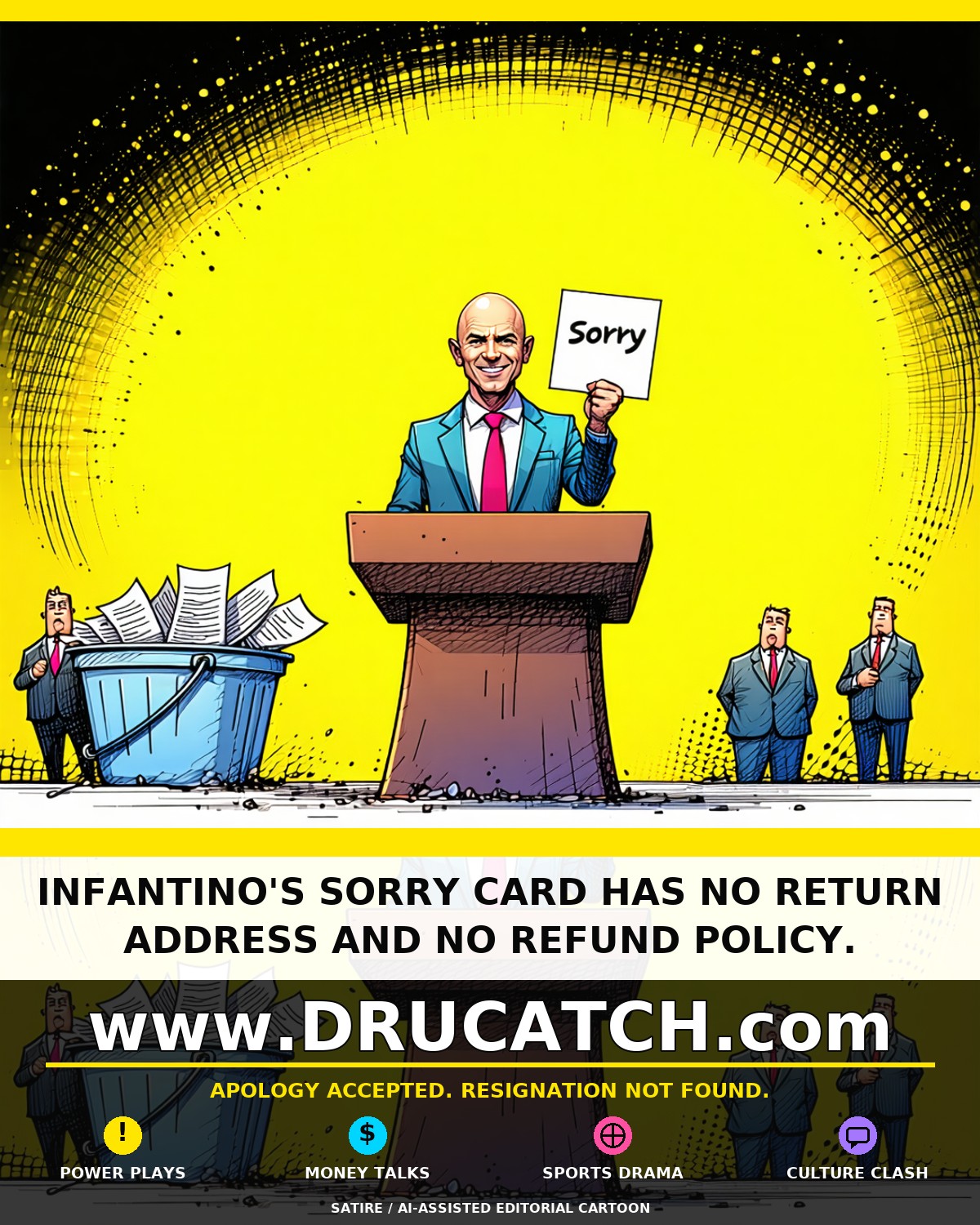
HOW DRU CATCH SEES IT
The Apology That Bounced Him Right Back Into His Chair
Most people understand that an apology works like a parachute: you deploy it on the way down. Gianni Infantino has invented a version that works like a trampoline — you deploy it and bounce right back to your original altitude. Speaking to the FIFA Council in Zurich, Infantino said sorry for his World Cup sell-off plan, the scheme that treated football's flagship tournament like a storage-unit auction with a better TV deal. Then he remained exactly where he was, behind the same desk, in the same chair, presumably in the same suit. The apology was the event. The consequences were not invited.
Europe Sent a Pink Slip, Infantino Read It as Fan Mail
The FA and other European football leaders, who evidently expected the word "sorry" to arrive stapled to a resignation letter, are still demanding he step down. And this is where FIFA's particular brand of institutional absurdity shines brightest: a president can propose commercializing the World Cup in ways that alarm an entire continent's worth of football associations, get caught, express regret, and then simply continue presiding. In any normal workplace, if you tried to hawk the company's crown jewel and got busted, your apology would be delivered while security watched you pack a box. At FIFA, the apology replaces the box.
Remorse as a Budget Line Item: Low Cost, Zero Deliverables
What Infantino has mastered is the apology that functions as a holding pattern — circling the runway indefinitely, never actually landing on accountability. European leaders can brandish their resignation demands like VAR flags, but FIFA's governance doesn't run on moral consensus; it runs on voting blocs. And voting blocs, unlike principles, respond to horse-trading, not indignation. The truly revealing detail isn't that Infantino apologized. It's that he clearly calculated, correctly, that saying sorry would cost him less than saying nothing — and infinitely less than actually leaving. At FIFA, remorse is a budget line item: low cost, zero deliverables, fully renewable.
THE COMMENTS SECTION HAS ENTERED THE CHAT
When a leader apologizes but refuses to resign, does the apology serve accountability or just buy time — and how should governing bodies handle the gap between contrition and consequence?
Join the discussion / save / share