HOW DRU CATCH SEES IT
The Safety Net With a Rubber Stamp
Citizens Property Insurance Corporation markets itself as Florida's insurer of last resort - a state-built backstop for homeowners priced out of the private market. A public-service framing, on its face. But ProPublica's September 2025 numbers paint a different institution: one that prevails in more than nine of ten mandatory arbitration disputes against the exact policyholders it was chartered to shelter. A safety net that catches the insurer more reliably than the insured is not a net. It is a toll booth planted at the only door out of a building that is already on fire.
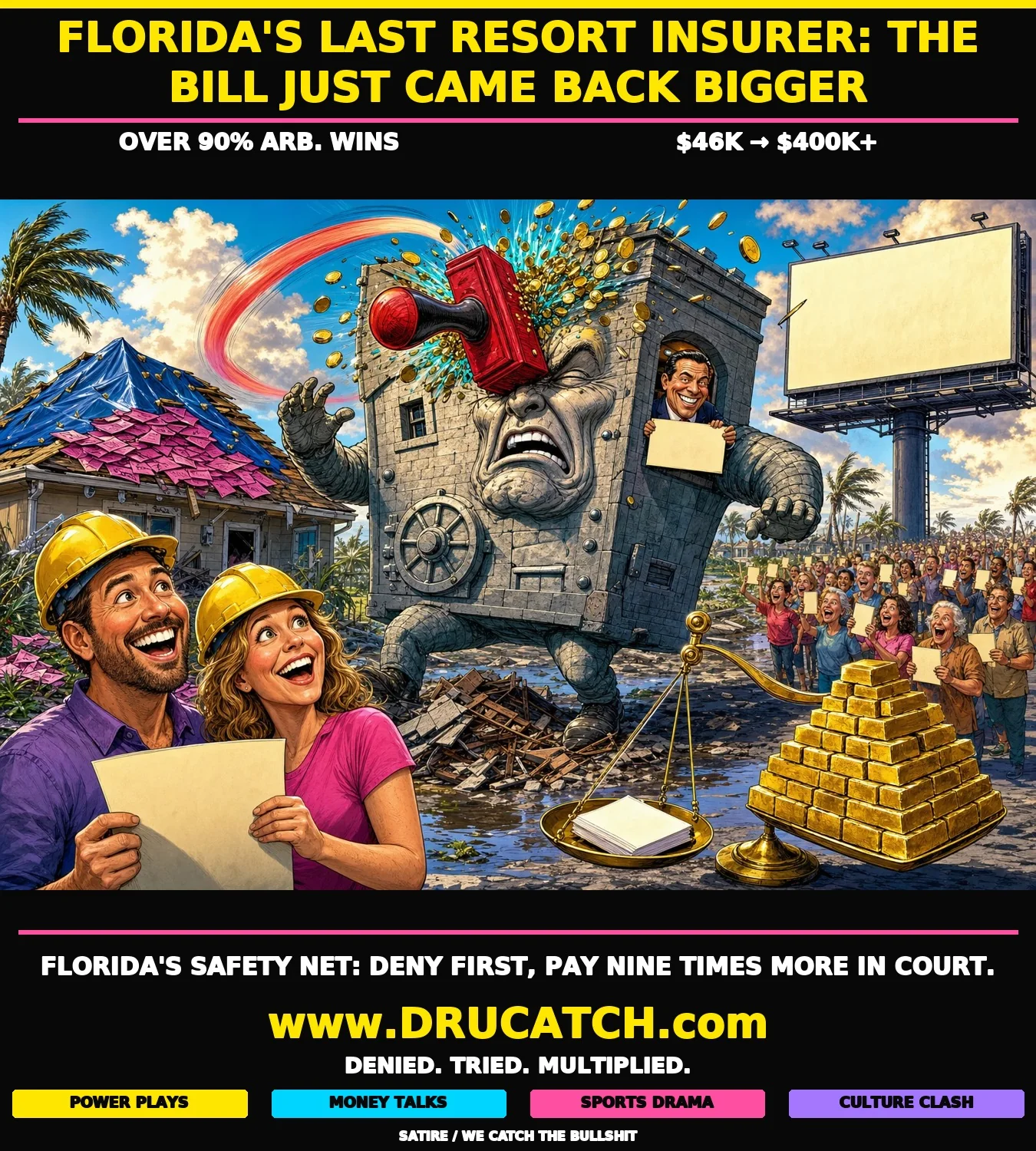
Bryan Guerra and Meghan Fitzgerald learned that lesson after Hurricane Ian tore through Florida on Sept. 28, 2022. Water intrusion later appeared in their roof. Citizens denied the claim, arguing the filing arrived late and that ordinary deterioration, not Ian, was to blame. Senior counsel Markus Kamberger countered that the roof had not exceeded its service life and that damage specialists traced the cause directly to the storm. A Broward County jury sat through a full trial and, in October 2026, sided with the couple. The insurer's months of delay and denial produced a bill that expanded from $45,950.93 to more than $400,000 - institutional stonewalling, itemized.
Follow the thread: United States: Trump Says "I Can Do Stuff That Is Unbelievable" - Voters Are Starting to Agree.
Redefining Denial Until It Disappears
Citizens CEO Tim Cerio put the insurer's denial rate at just 13% across Hurricanes Debby, Helene, and Milton. The figure rests on a definition engineered to shrink: claims closed with zero payment because they fell below the deductible, or because the damage category sat outside coverage, do not register as denials under Citizens' internal accounting. Independent financial analyst Martin Weiss of WeissRatings offered a blunter arithmetic to NOTUS: receiving a letter that closes your claim without a cent is a denial, regardless of the vocabulary attached to it. A state-backed institution that constructs its metrics so that most of its non-payments disappear from the ledger is not practicing risk management. It is practicing press-release management.
Insurify's 2024 reporting found that a large share of Hurricane Helene and Milton claims submitted to Citizens were closed without payment, and that roughly three-quarters of Hurricane Debby claims ended the same way. The Washington Sun documented how Citizens' narrow definitional frame allows those figures to evaporate from the official denial rate. Florida's governor's office announced an average 8.7% premium reduction for Citizens policyholders in response to the broader controversy - a price adjustment, not a structural fix to the claims process.
The Real Deductible Nobody Quotes
Consider the actual cost of collecting. Lead counsel Patrick Montoya described the Guerra-Fitzgerald matter as a David-and-Goliath contest. It consumed nearly two years and required hundreds of thousands of dollars in legal work before the verdict landed. Florida already carries the nation's highest average home insurance premiums in 2026, per Insurance.com data, and private carriers have retreated so thoroughly from the market that hundreds of thousands of homeowners have no realistic alternative to Citizens. The unstated deductible for pursuing justice is one most policyholders cannot absorb.
The October 2026 verdict is a genuine win - Montoya noted after the ruling that his team knew they could tie the damage to Hurricane Ian and deliver a result for a family fighting a much larger adversary. But a structure in which homeowners must invest two years and six-figure legal costs to recover on a sub-$50,000 claim is not a functioning safety net. It is a system that calculates, accurately most of the time, that its own customers cannot sustain the fight long enough to prove it wrong.



THE COMMENTS SECTION HAS ENTERED THE CHAT
Citizens Property Insurance Corporation is a state-created insurer of last resort, yet ProPublica found it wins over 90% of mandatory arbitration disputes against its own policyholders. Should a government-backed insurer that wins the vast majority of claims disputes against its own customers be considered a public safety net - or something else entirely?
Join the discussion / save / share