HOW DRU CATCH SEES IT
The Perpetual Panic Machine Runs on Weekly Amnesia
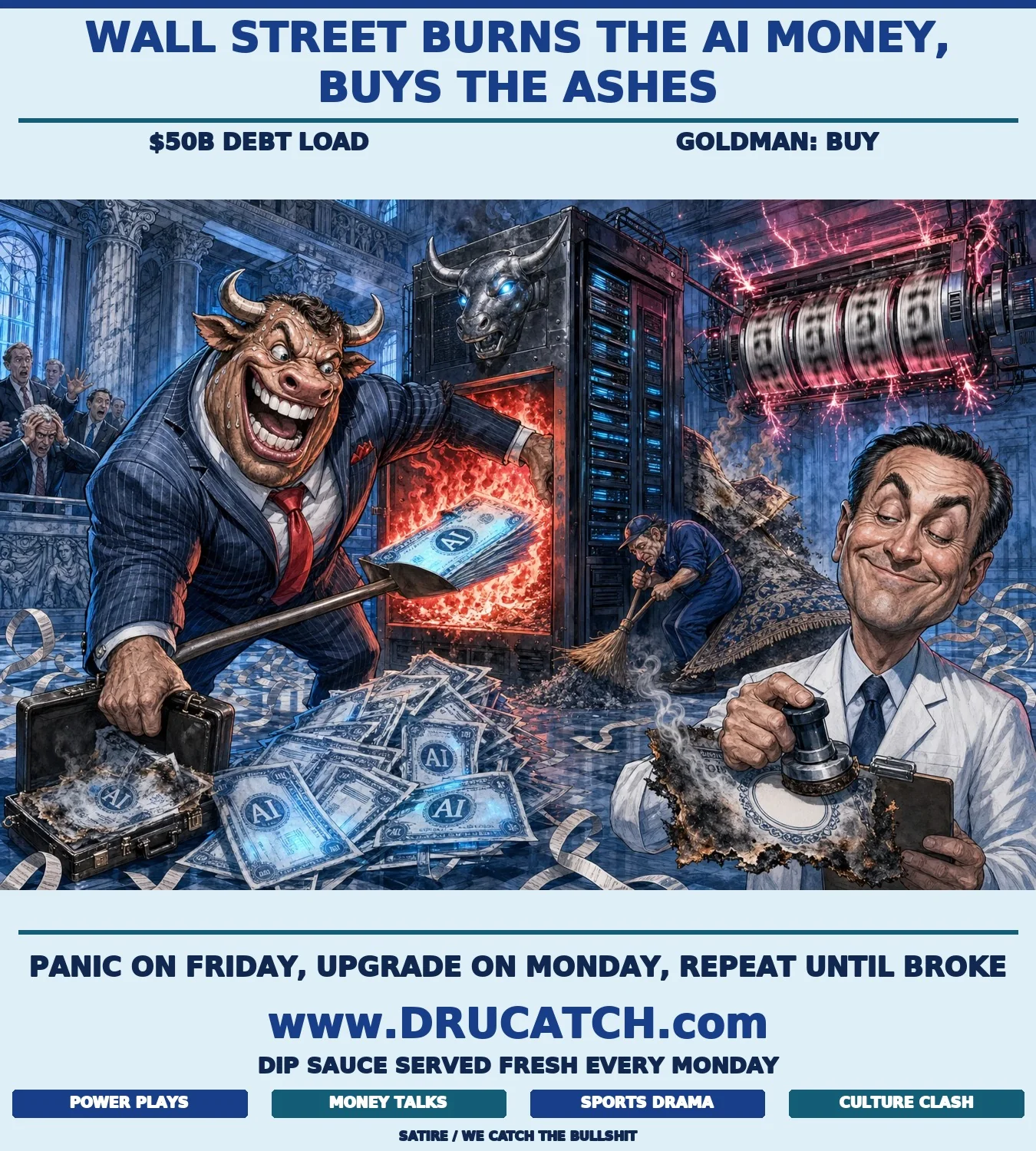
Wall Street just did the financial equivalent of running screaming from a house fire on Friday and strolling back in Monday to check if the fridge has anything good. The Nasdaq posted its worst week since June because investors suddenly realized that building the AI future requires actual money - borrowed money, specifically, at interest rates that make the bill significantly worse. CoreWeave alone is sitting on a $50 billion debt load that spooked the entire sector into a selloff so violent the company lost a quarter of its value. So naturally, Goldman Sachs looked at the wreckage and said "buying opportunity."
When the Bull Case Is "It Just Got Cheaper Because Everyone Panicked"
That's the beautiful perpetual motion machine of modern markets: panic creates a dip, a dip creates an upgrade, an upgrade creates a rally, and the rally re-inflates the exact bubble that caused the panic. Nobody fixed the underlying problem. Interest rates didn't drop over the weekend. CoreWeave didn't pay off $50 billion in debt between Friday's close and Monday's open. The "costly AI build-out" is still costly. Investors just decided to worry about it again later - presumably next Friday, when the cycle resets.
A Discounted Grenade Is Still a Grenade
The real joke is Goldman calling a stock that fell 25% on legitimate debt concerns a "buying opportunity" rather than, say, a "financing red flag with a brief markdown." When your bull case for a company is "it just got cheaper because everyone realized its balance sheet is terrifying," you're not investing. You're picking up a discounted grenade and calling it a doorstop. The AI gold rush has reached the phase where the question isn't whether the technology works - it's whether anyone can afford the electric bill. And Wall Street's answer, apparently, is to stop asking and start buying.
THE COMMENTS SECTION HAS ENTERED THE CHAT
When a major bank upgrades a stock days after it crashed 25% on debt concerns, is that legitimate analysis or just the sell-side manufacturing the next rally from the rubble of the last panic?
Join the discussion / save / share