HOW DRU CATCH SEES IT
The 38-Second Trademark Dispute
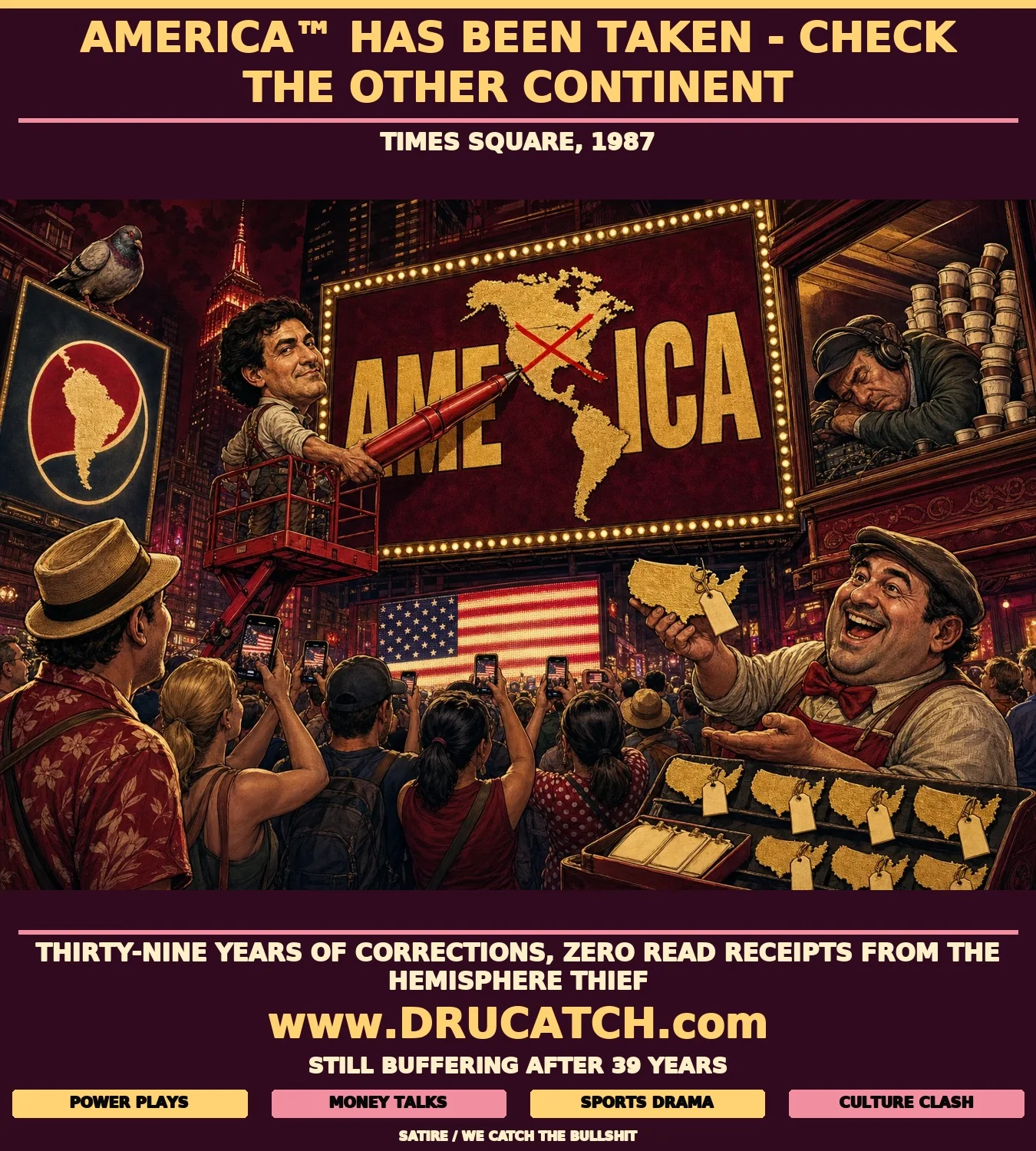
The United States has always been the world's most aggressive brand. It didn't just name itself after a continent - it quietly trademarked the whole hemisphere, and then spent decades exporting that trademark in Coca-Cola cans and airstrike press releases. When a Chilean architect politely posted a 38-second semiotic notice on the most commercial real estate on Earth in 1987, the correction lasted exactly as long as a Pepsi ad and was absorbed with roughly the same cultural impact. The hemisphere remained branded. The billboard moved on.
Jaar told Observer the work began as a 'semiotic exercise': he had arrived from Chile already considering himself American - 'Soy un americano' - and found the daily linguistic usurpation of that identity simply wrong. The correction was precise: a U.S. map labeled 'This Is Not America,' a U.S. flag labeled 'This Is Not America's Flag,' and finally the word 'AMERICA' expanding across the screen with its 'R' morphing into the landmass of North, Central and South America. Thirty-eight seconds. Sandwiched between commercials. On the most watched billboard in the world. And yet here we are.
When Your Correction Needs a Sequel, a Remix and a Gallery Show
What makes Jaar's story genuinely funny in the darkest possible way is the relay race his correction has required. A 1987 Times Square animation. A 2022 Puerto Rican rap track - 'This Is Not America' by Residente and Ibeyi - directly echoing the same message 35 years later. A 2026 gallery show at Galerie Lelong New York, more than a year into the second Trump administration, presenting the original work as urgent contemporary speech. Three generations of artists, across three different media, all saying the same thing. Per Jaar's own assessment, the people most in need of hearing it still haven't looked up from the sidewalk.
Jaar called the Residente song 'marvelous' and said it was an honor that his work served 'as a kind of starting point' for it. Which is generous. But a correction that has required a multi-generational relay race and is still mid-race is not a correction that has landed. It is, at this point, a subscription service for a letter nobody opens. Invoking Gramsci, Jaar holds that art and culture change things 'slowly rather than spectacularly.' Thirty-nine years in, slowly is doing a lot of work in that sentence.
The Hiding Stopped. The Backyard Didn't.
The real bite in Jaar's argument isn't the map joke. It's the structural observation underneath it: the same country that spent the Reagan years secretly funding Contra forces in Nicaragua while publicly branding itself as freedom's global headquarters is now - per Jaar speaking to Observer - openly treating Latin America 'as a backyard, with no respect whatsoever for sovereignty.' The Iran-Contra scandal was dominating Washington the very weeks Jaar's animation ran in Times Square in April 1987. The brand hasn't changed. The hiding has just stopped.
Jaar frames that as accidental transparency: 'Now, thanks to Trump, everything is transparent. Everything is quite evident. There is no more hiding.' He also describes oligarchs acquiring social media platforms and traditional media to alter algorithms and silence shifting narratives as 'pure fascism.' The machinery is visible. Whether visibility alone constitutes progress is the question Jaar refuses to answer with false optimism - he stops short of calling himself hopeful. Art, he says, makes 'a little crack in the system.' From that crack to changing the world is, in his words, 'a huge step.' He's not wrong. He's just been standing at that crack for 39 years, correction in hand, while the billboard sells something else.
THE COMMENTS SECTION HAS ENTERED THE CHAT
If a 38-second billboard correction in 1987, a major rap song in 2022 and a gallery show in 2026 all make the same argument and the underlying policy hasn't shifted, at what point does "raising awareness" become its own form of institutional comfort - and who does that comfort serve?
Join the discussion / save / share