HOW DRU CATCH SEES IT
The Column That Came With Stage Directions
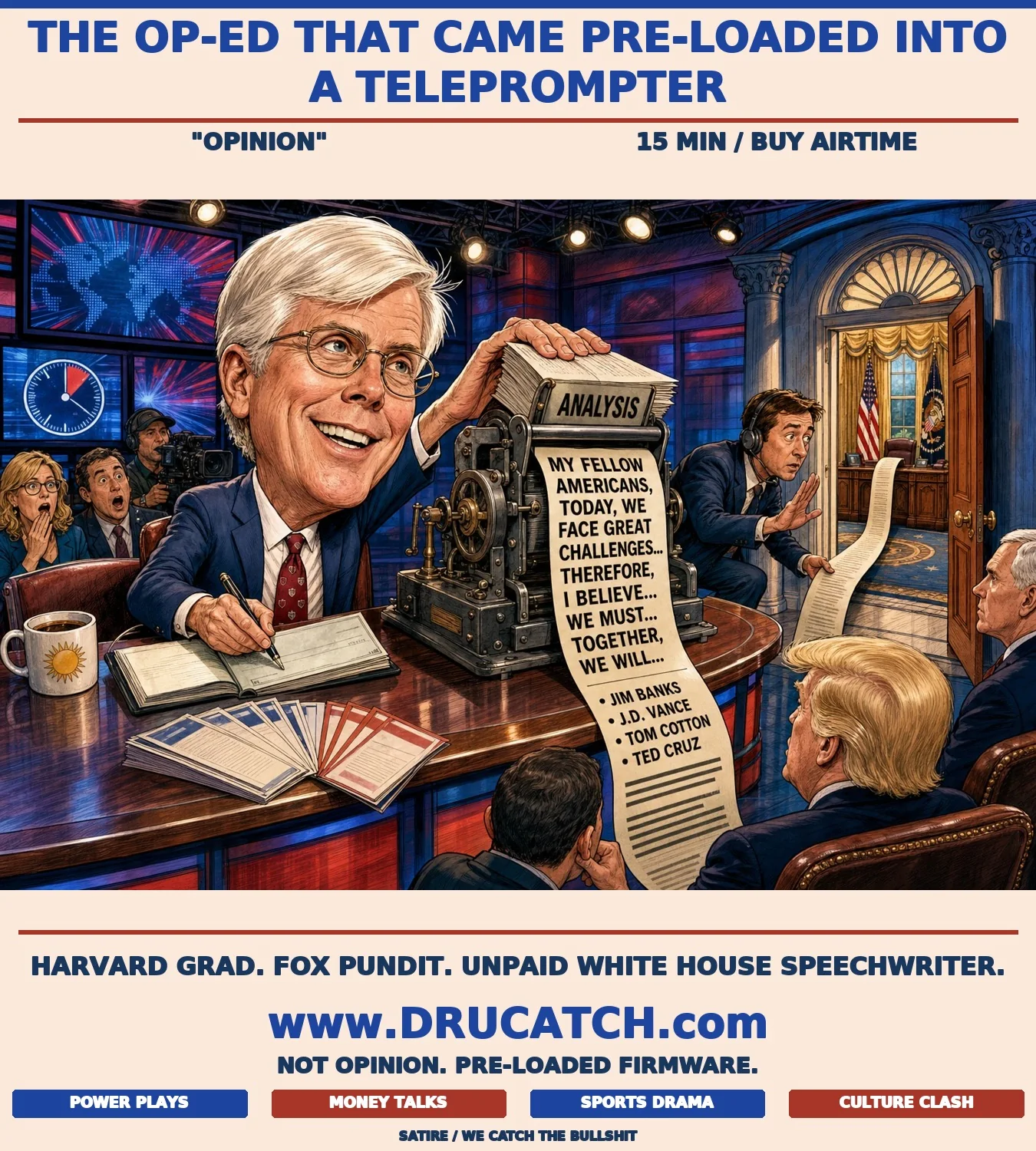
There is a long and mostly harmless tradition of opinion columnists telling presidents what to do. Write a tighter speech. Be more decisive. Stop doing the weird thing with your hands. Hugh Hewitt's October 22 Fox News column is something else. It does not argue that Trump should make a midterm closing argument - it manufactures one for him, down to the runtime ('a tight 15 minutes'), the distribution strategy ('the Trump PAC may even want to buy network time'), the specific Senate names to drop, and the literal words to say at the end.
The suggested closing is not a paraphrase of what Hewitt hopes Trump will convey. It is a finished script, in quotation marks, attributed to a president who has not yet given the speech. 'America's Golden Age is indeed upon us. I need your vote, and so do these great Republican candidates.' That is either a ghost-written speech or a very confident prediction. The column treats the distinction as irrelevant.
When the Pundit's Show Covers the Pundit's Strategy Memo
The column's own bio line finishes the argument. It notes the piece 'previews the lead story that will drive his radio/TV show today.' Follow the circuit: Hewitt publishes the strategy memo as opinion journalism, his show reports on the memo, the president - ideally - delivers the speech the memo drafted, and Hewitt's show covers that event too. The column is simultaneously the cause, the content and the anticipated coverage of a political event it is nominally analyzing from the outside.
This is not a hidden arrangement. Hewitt states it plainly. The transparency makes it stranger, not less strange. Fox News opinion pages have long been understood as a parallel communications channel for Republican politics, but here the channel is routing a specific script toward a specific speaker with a specific broadcast window attached. Calling this 'analysis' requires the word to do more work than it was designed for.
"Opinion" Is Not a Magic Spell
None of this is secret or illegal. Opinion journalism has always been advocacy, and partisan columnists have always hoped powerful readers act on their columns. The distinction worth naming is between 'here is what I think the president should argue' and 'here is exactly what he should say, for exactly 15 minutes, bought on network time, seeded with these four candidate names, and closed with this sentence.' At that point the Opinion label is doing the intellectual equivalent of a single wet traffic cone blocking a highway: technically present, practically insufficient.
The historical examples Hewitt cites are genuine - Biden's 2022 DNC address, Bush's 2006 press conference - and his analytical takeaway (a speech can mobilize a base; a press conference cannot) is defensible political commentary. The problem is that the analysis occupies about four paragraphs and the ghostwritten speech occupies the rest. The Harvard Law credential is deployed to distinguish between two formats of presidential communication. The product of that distinction is a draft marked up for delivery. That is not disqualifying. It just isn't analysis.

THE COMMENTS SECTION HAS ENTERED THE CHAT
When a news network's opinion columnist supplies a sitting president with a verbatim speech draft, a production schedule, a PAC media-buy recommendation, and a candidate endorsement list - all framed as analysis - where exactly does commentary end and campaign coordination begin? Does the "Opinion" label cover all of it?
Join the discussion / save / share