HOW DRU CATCH SEES IT
An Invoice Addressed to Alabuga Is Not Subtle Sanctions Evasion
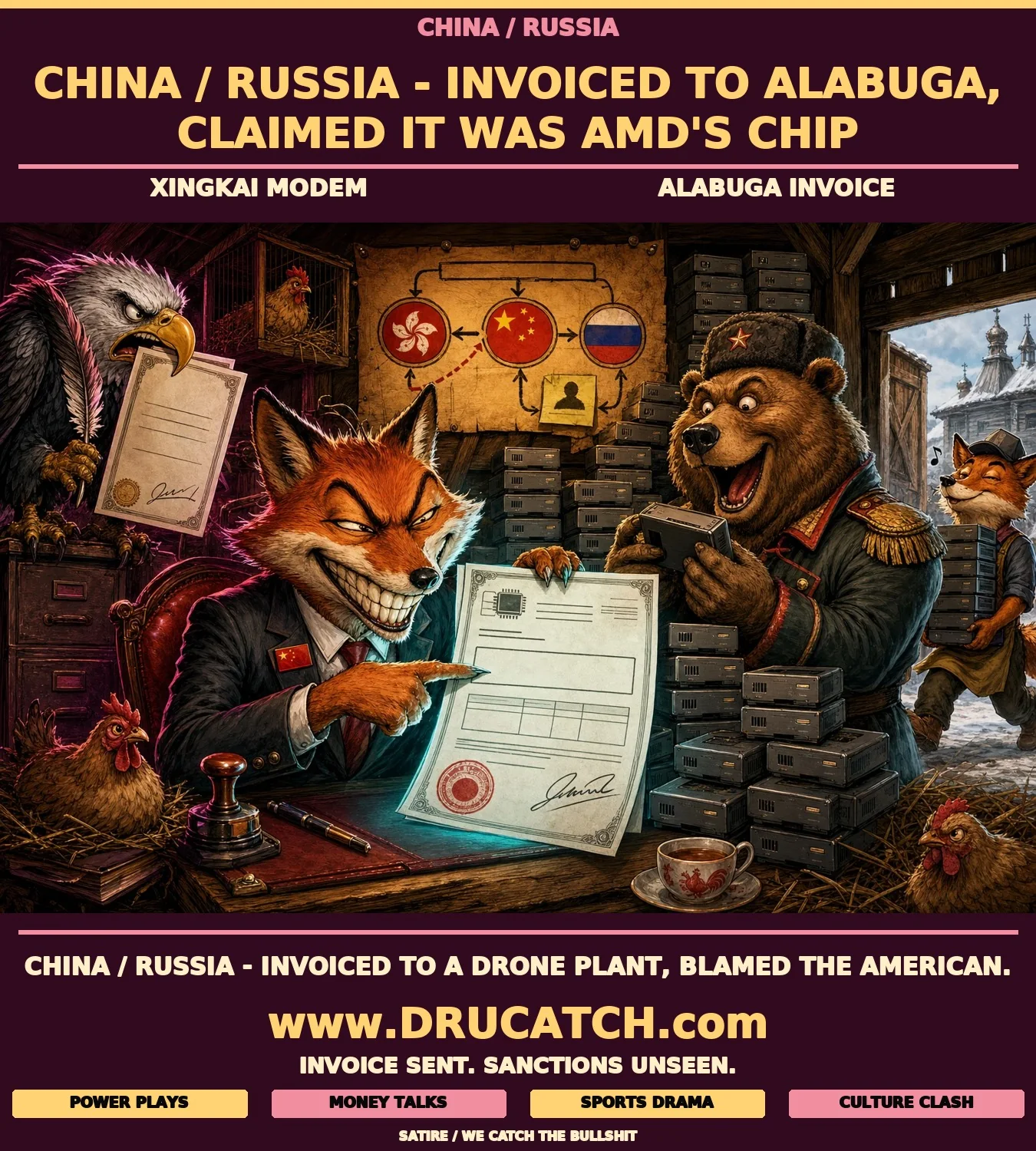
Export controls are only as effective as the visibility of the supply chains they govern - and Xingkai apparently saw no need to hide at all. Undercover reporters skipped the tradecraft entirely: no forged identities, no dead drops, no bribed intermediaries. They opened WeChat, introduced themselves as a Russian military supplier, and placed an order. The firm's director processed it, set a price of roughly 19.5 million yuan, and dispatched an invoice bearing the word Alabuga in Latin letters - the home of Russia's principal long-range drone factory - as the named destination.
More striking still, the reporters stated outright during the conversation that their end user was a military production facility. According to The Insider's account, that declaration produced no hesitation and no refusal. A follow-up request to update the delivery address yielded a revised invoice, this time routing settlement through a third bank account registered to a former Xingkai manager who had departed the company in 2025. That kind of sequential rerouting - through a DBS account in Hong Kong, a personal Ping An account, and finally a China Merchants account in a former employee's name - reads less like routine bookkeeping and more like a well-rehearsed financial relay race.
Dropping AMD's Name While Invoicing a Drone Factory Is a Special Kind of Bold
Alongside the invoice itself, the firm's director volunteered that the modem's key programmable chip originates with AMD. When the reporters requested documentation of an AMD license, he declined - the chips arrive through a middleman, he explained, a structure in which each link in the chain can claim clean hands while the component moves steadily toward a sanctioned end user. It is a familiar architecture, and it functions precisely because no single party is required to know where the part ultimately lands.
AMD's response left little ambiguity: the company stated that Xingkai is neither a customer nor an authorized partner, and confirmed it has no record of selling the firm anything. AMD further noted that it prohibits exports of its products to Russia where those transfers would breach US export controls or sanctions. The director had therefore casually attributed a key component to a prominent American semiconductor company - while simultaneously completing a modem sale to a Russian military facility - apparently unconcerned that the named supplier might not share his version of events. Whether that reflects extraordinary confidence or a practiced indifference to paper trails is left as an exercise for enforcement agencies.
Half the Mesh Modems, Zero Sanctions - The Network Is the Weapon
What the investigation surfaces is not an isolated case of one firm cutting a corner. The Insider's reporting estimates that Xingkai accounts for roughly half of the high-power mesh modems Russia deploys to coordinate drone attacks on Ukraine - components that keep an entire strike swarm networked even after losing close to 80 percent of its units, according to a Ukrainian defense adviser cited in the piece. The XK F-359 that reporters pulled from an upgraded Gerbera drone reportedly sustains a line-of-sight connection across 100 to 300 kilometers. Stack two relay drones above a corridor and a full attack on Kyiv stays connected, commands can be updated mid-flight, and air defense routes can be adjusted in real time.
The modems that enable all of this remain unsanctioned. That is the sharpest edge of The Insider's argument: Western policy has concentrated attention on the airframes while the communication layer powering them has stayed off every restricted list. The outlet argues that Ukrainian energy infrastructure this winter is partly hostage to how quickly that gap is closed. The invoice addressed to Alabuga has already been drafted, priced, and routed through three banks. The outstanding question is whether anyone with authority to act will read it before the next strike campaign begins.
THE COMMENTS SECTION HAS ENTERED THE CHAT
If undercover reporters can order 500 sanctioned-adjacent drone modems from a Chinese firm via WeChat in an afternoon - complete with an invoice addressed to a Russian military drone plant - what does that say about the real-world enforcement of international export controls?
Join the discussion / save / share