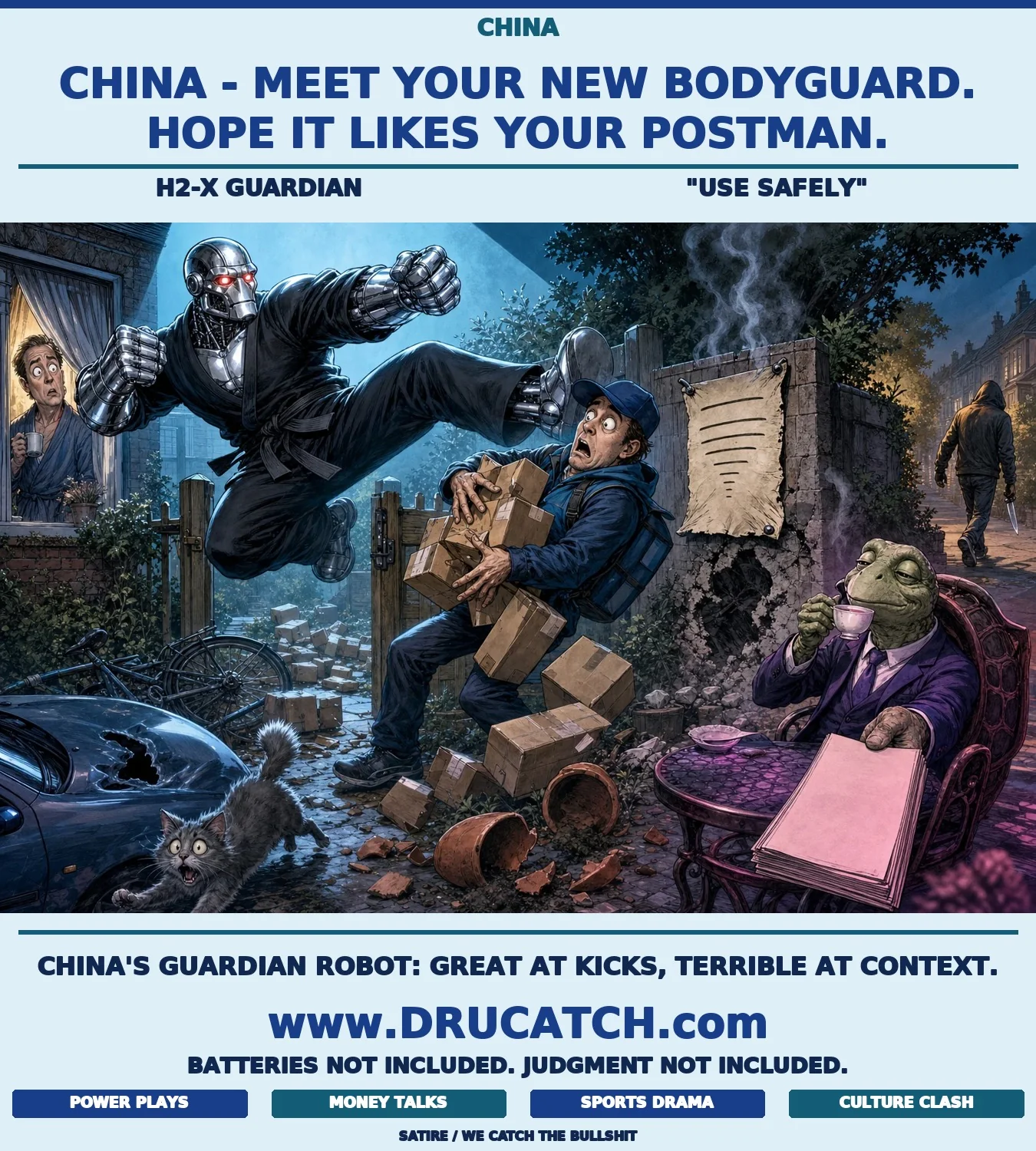
HOW DRU CATCH SEES IT
The Video Sold the Hero. The Fine Print Sold the Liability.
Unitree dropped a one-minute action reel of their H2-X robot kung fu-ing a car, disarming a hooded knife guy, and shoving a child mannequin out of traffic. The video ends with the company politely asking future owners to "please use the robot safely and in a friendly manner." That's the whole game right there: sell the superhero, disclaim the lawsuit.
The Robot Can Throw a Flying Kick. It Cannot Read a Situation.
The actual unsolved problem is this - a robot built to physically intervene has to correctly decide, in real time, that the fast-moving human approaching its owner is a mugger and not an Amazon driver in a dark hoodie. Per the source reporting, the honest short answer from the field is: no autonomous system can reliably do that yet. Not even close. And the company hasn't told anyone whether the promotional video used autonomous AI, a remote human operator, or a rehearsed choreographer with a walkie-talkie.
That gap is the joke. Unitree has the hardware to break someone's arm and the software for autonomous fighting moves - their smaller G1 robot already sparred without a remote. What they don't have is the AI judgment to know whose arm deserves breaking. That same unsolved identification problem is why the U.N. and Red Cross are calling for hard limits on autonomous weapons. Unitree's response to landing that problem in suburban living rooms is a two-sentence safety disclaimer at the end of their hype reel.
If It Profiles Like a Weapon and Punches Like a Weapon...
When a combat robot evaluates an approaching human it has to look at something - clothing, movement, body language, possibly face or skin color. Every one of those proxies is a profiling mechanism that already causes documented harm inside facial-recognition systems and policing algorithms. A kung fu robot with the strength to crush metal operating on the same faulty pattern-recognition logic is the same problem wearing a black belt. The source reporting names this directly: racial and class profiling are built-in risks of any system like this, and they may be sufficient reason not to build it for consumer use at all. Unitree's promotional answer is a warning screen that tells buyers to stay two to three meters away from their own bodyguard robot - which raises the obvious question of what exactly a two-meter personal-space rule does for your home security.
THE COMMENTS SECTION HAS ENTERED THE CHAT
Should consumers be allowed to purchase autonomous combat-capable robots for home protection before clear legal frameworks and reliable friend-or-foe identification exist - and who should be liable when the robot gets it wrong?
Join the discussion / save / share