HOW DRU CATCH SEES IT
The Announcement Is Free. The Donation Costs Extra.
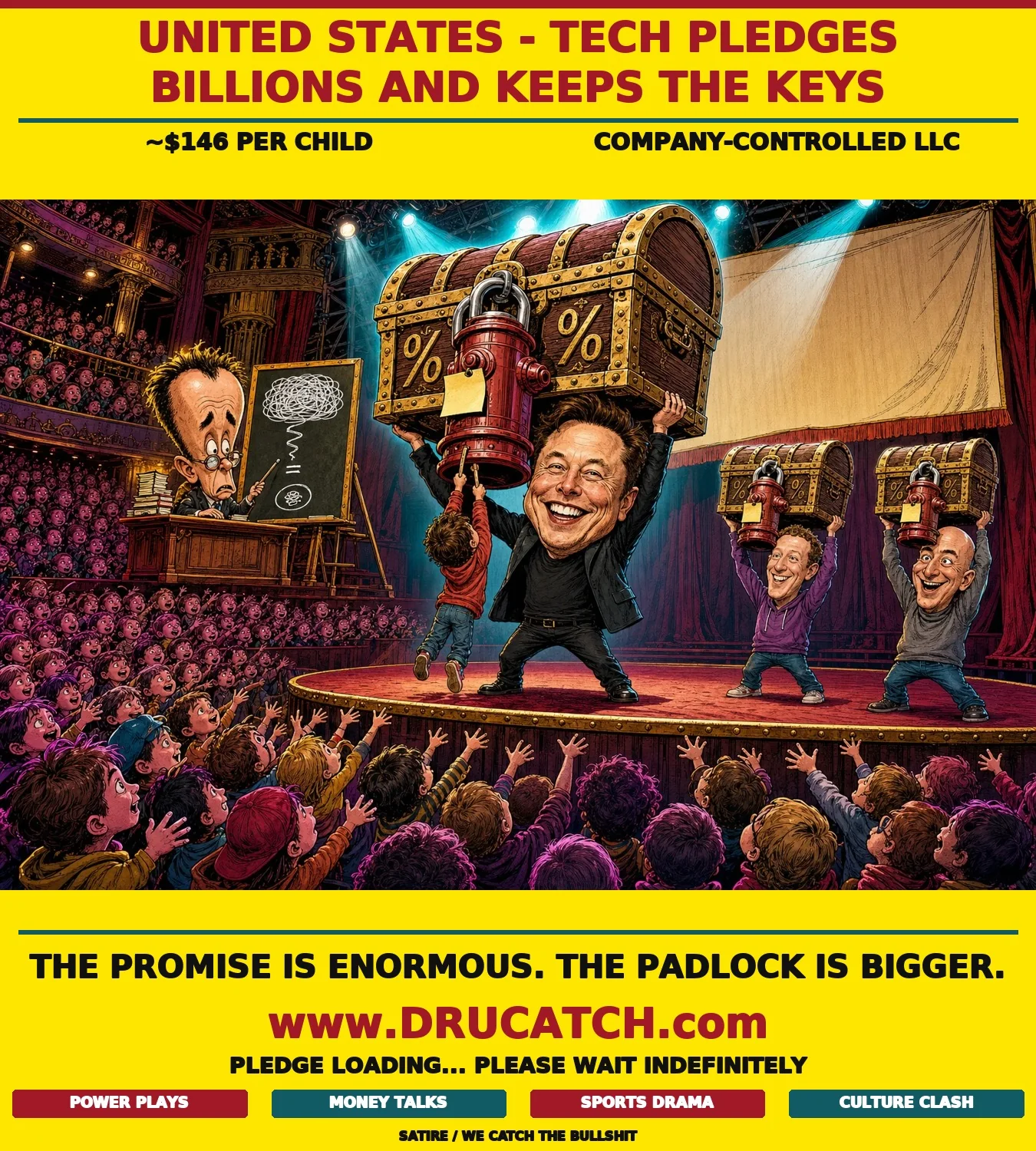
Silicon Valley has made a bracing discovery: the press release costs nothing, and the cheque costs everything. Musk's vow to hand every American child a SpaceX share is genuinely staggering at scale - roughly 72 million shares, around $10.5 billion at recent prices. Zoom to the individual child, however, and that resolves to approximately $146, no delivery mechanism has been named, and the shares would apparently arrive inside Trump Accounts rather than in anyone's pocket. Grand on the banner. Modest in the envelope. Silent on the logistics.
Anthropic's architecture is more elaborate still. Its proposed 5% stake - roughly $48 billion at the company's most recent valuation - would be housed inside a company-controlled LLC, leaving Anthropic to determine when and how any funds actually move. Brian Mittendorf, an accounting professor at Ohio State University, frames the standard clearly: proper philanthropic commitment means money genuinely committed upfront, not merely an intention declared. A donor-controlled LLC with lighter disclosure requirements than a conventional charity sits considerably further from that standard than the headline figure suggests.
Who Controls the Chest Controls the Charity
Bella DeVaan of the Institute for Policy Studies offers a dataset worth studying. The 32 original American Giving Pledge signatories still counted as billionaires in 2025 had collectively grown 283% wealthier since they signed - 166% in inflation-adjusted terms. Among 22 who had since died, just eight had followed through. DeVaan's pointed question - what mechanism actually holds a pledger accountable? - has not been answered from any of this month's announcement stages, and the Giving Pledge numbers suggest the silence carries weight.
OpenAI occupies a different position from the others: it has genuinely begun dispersing money. Its People-First AI Fund has directed $100 million to community organisations, with a further $50 million tranche announced this month. Even so, its $25 billion commitment toward disease research and AI resilience is still overwhelmingly a declared target rather than a completed transfer. Jay Ritter at the University of Florida argues the pledges deserve to be taken at face value, and the long tradition of wealthy entrepreneurs funding serious causes supports some optimism. The tradition of wealthy entrepreneurs not finishing the job supports DeVaan's spreadsheet.
Philanthropy With a Password You Don't Own
The structural comedy here is hard to miss. These are companies whose core business proposition is controlling the future - the data, the model, the output, the roadmap. Their philanthropy follows the same blueprint: donors control the assets, the schedule, the eligible recipients and what gets disclosed to whom. Anthropic's LLC retains board discretion over timing. Musk's children will own stock certificates, not cash, inside accounts tied to an administration with its own uncertain shelf life. The public receives the headline. The chest remains padlocked.
None of that makes the pledges fraudulent. It makes them promises, which is a softer and considerably squishier category. The sums announced this week are attached to real companies with real valuations. Whether they eventually reach real people depends entirely on the institutions that issued the announcement - and on accountability mechanisms that, as of the time of writing, remain entirely unspecified.
THE COMMENTS SECTION HAS ENTERED THE CHAT
Should philanthropic pledges from companies and billionaires be legally enforceable within a defined timeframe, or is public accountability enough to hold donors to their commitments?
Join the discussion / save / share