HOW DRU CATCH SEES IT
New York's $1.875 Million Penalty Has a Missing Recipient
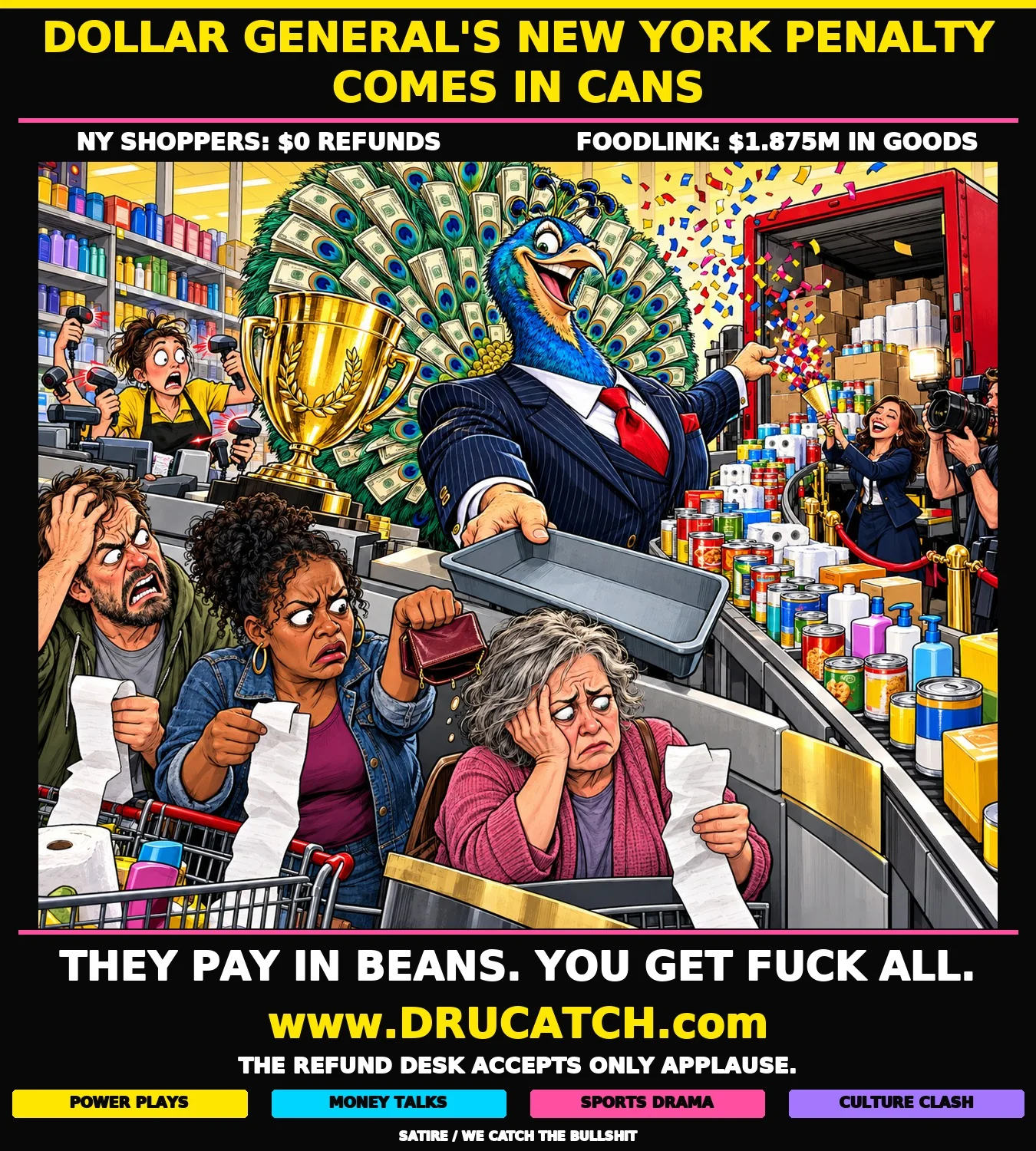
Dollar General has settled overcharging cases in New York, Ohio and Pennsylvania for a combined amount approaching $4.4 million. That does not make the terms of those cases interchangeable. The particularly ridiculous arrangement here is New York's $1.875 million civil penalty: it is paid in donated goods to Foodlink, while the customers overcharged under that settlement get nothing back. A food bank does useful work. It is also a spectacularly convenient place for a corporate penalty to land when the people holding the receipts are waiting somewhere else. The company gets to send out goods. The shopper still gets to do the subtraction.
We Deny Everything, We Are Very Sorry, Here Are Some Beans
Dollar General denied wrongdoing in the Pennsylvania case and a separate national lawsuit. Asked about New York, it did not clarify whether it disputes the attorney general's findings. Its statement stressed accurate on-shelf prices and disappointment whenever it falls short. In Dru Catch's imaginary boardroom, that becomes a three-part customer-service package: deny, look disappointed, wheel out the canned goods. That is parody of the corporate performance, not a quotation or a reported photo event. The contradiction needs no invented conspiracy. New York found overcharges; the penalty goes to a nonprofit; the overcharged customers receive no direct reimbursement from that settlement. Accountability apparently has a very generous community-relations department and an impressively difficult-to-find refund desk.
When Understaffing Is the Business Model and Disappointment Is the Fine
The Guardian linked widespread price-accuracy failures to thin staffing: register prices update automatically while employees struggle to replace shelf tags. Its review found more than 4,300 failed inspections across 23 states since January 2022. Dollar General says its store teams are instructed, expected and empowered to fix discrepancies. There is a wonderful corporate trick in expecting an overstretched workforce to be the safety net for an understaffed system. The register gets an automatic update; the shelf gets whoever has a spare minute; the customer gets a surprise. In New York, the response includes signs, audits and pricing corrections, but no refunds under this settlement. The food donation may help people. It still does not turn the original shoppers' receipts into reimbursement checks.
THE COMMENTS SECTION HAS ENTERED THE CHAT
When a company settles a consumer fraud case, should the penalty money go directly to the people who were overcharged - or is donating to charity a legitimate substitute for restitution? And if a chain fails 4,300 price inspections across 23 states while denying wrongdoing, at what point does "disappointment" stop being an acceptable corporate response?
Join the discussion / save / share