HOW DRU CATCH SEES IT
Four Countries Accused, Zero Investigations Opened
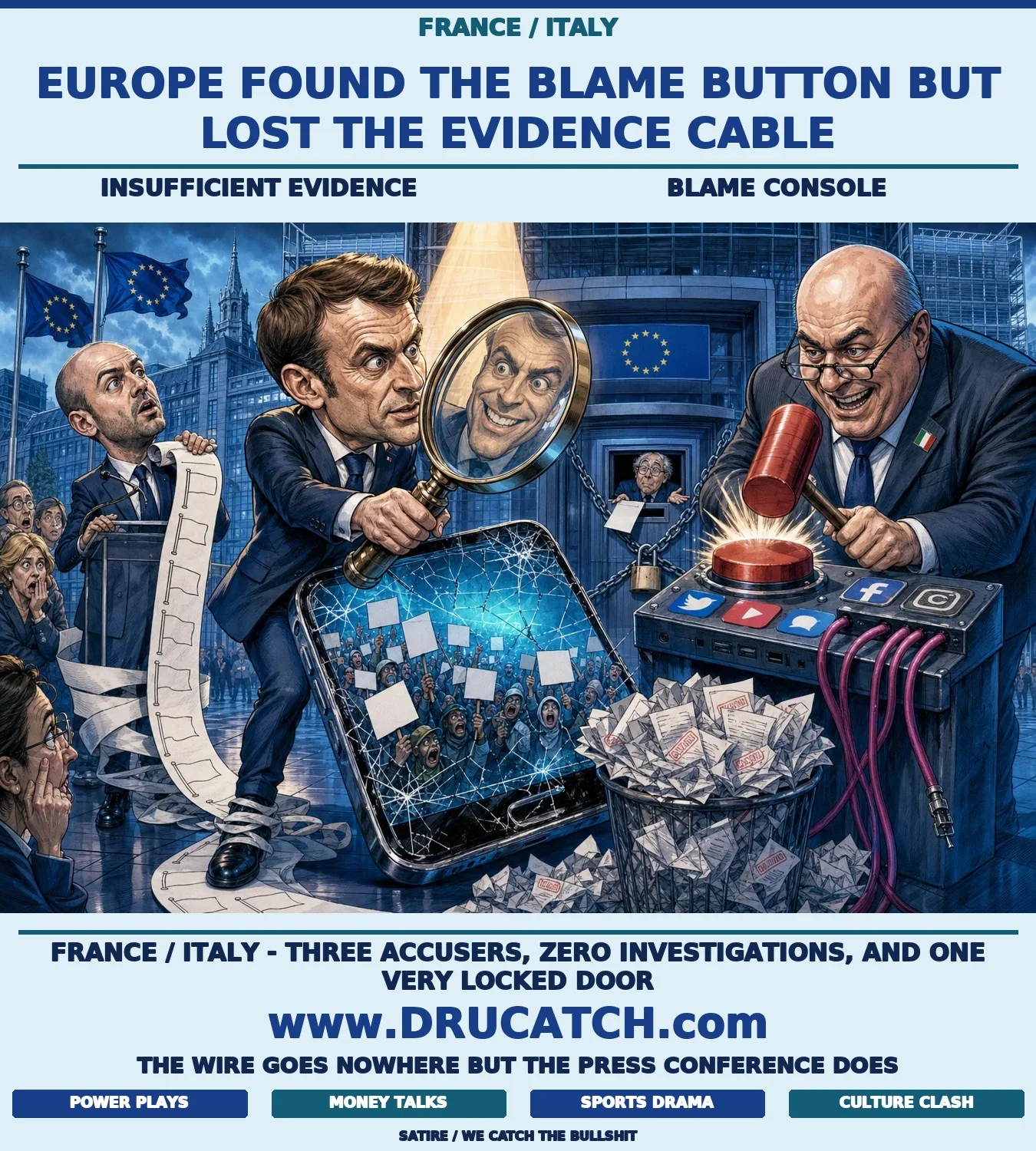
Europe's top officials can't decide whether foreign actors started the riots or just retweeted them, and the distinction matters enormously when you're asking Brussels to activate emergency powers over online platforms. Macron drew the line clearly: no evidence of provocation, only exploitation afterward. His own foreign minister then crossed that line by naming Russia, China, Iran, and - for some reason - the "MAGA community" as hostile actors who exploited student protests. Italy's defense minister went further, calling Milan's unrest a full "hybrid war" waged through TikTok and YouTube. The European Commission, meanwhile, looked at all of this and essentially said: we'll wait in the car.
A Bureaucratic Loop Where Nobody Wants to Pull the Trigger
The contradiction is spectacular. Three governments are demanding Brussels open an official investigation under the Digital Services Act. Brussels says the evidence doesn't justify it. National regulators in France and Italy already have the legal tools to act but apparently prefer that someone else pull the trigger. The DSA even includes a crisis mechanism granting the Commission emergency powers over platforms - a nuclear option nobody wants to be the first to press. So here's what Europe has built: a system where national officials publicly accuse foreign governments of information warfare, national regulators ask the EU to investigate, the EU says the evidence is insufficient, and everyone goes back to holding press conferences about the threat nobody can officially confirm.
Retweeting a Fire Is Not the Same as Lighting One
Per Euronews, disinformation networks associated with Russia's Overload and Doppelgänger operations did amplify existing violence online. That's real. But amplification after the fact is not causation, and conflating the two while demanding emergency powers is the kind of rhetorical sleight-of-hand that should make everyone nervous - including the people doing it. It's the institutional equivalent of four people standing around a flat tire, each insisting someone else has the jack. The accusation becomes the policy, the press conference becomes the investigation, and the evidence remains what it was at the start: insufficient.

THE COMMENTS SECTION HAS ENTERED THE CHAT
When national officials publicly blame foreign actors for domestic unrest but their own institutions say the evidence is insufficient, who benefits from the accusation itself - and does the lack of a formal investigation make the claim more or less politically useful?
Join the discussion / save / share