HOW DRU CATCH SEES IT
The Announcement and the Asterisk
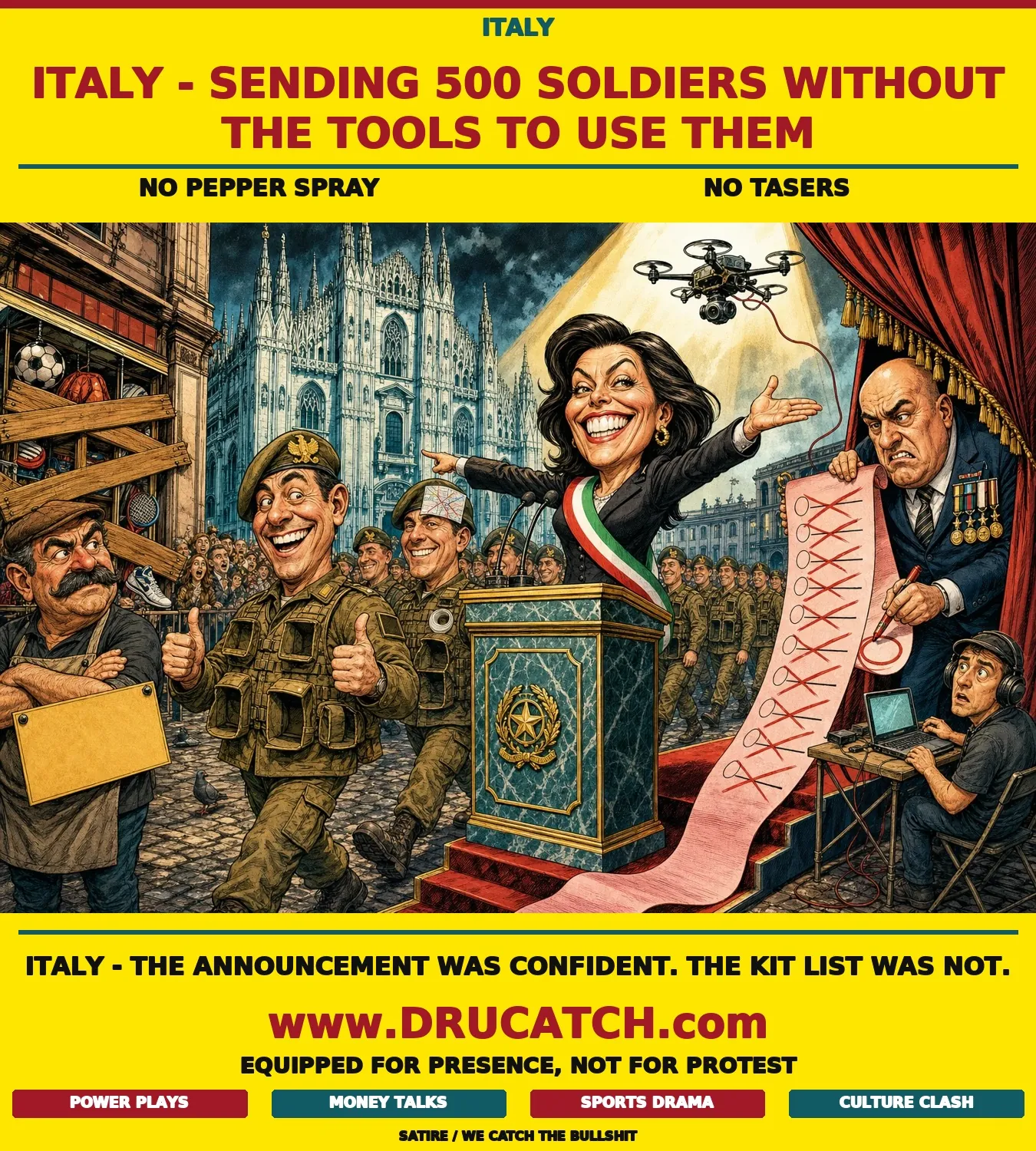
Italy's government had a full week between last Saturday's looting in Milan's sneaker district and this Saturday's expected follow-up demonstrations. Premier Giorgia Meloni's response: 500 additional soldiers, drone surveillance overhead, rapid-response units on the ground, and tougher penalties targeting the minors who police say formed a substantial portion of the violent crowd. Taken at face value, that looks like a government treating a genuine security problem with genuine urgency.
Then Defense Minister Guido Crosetto published the appendix. In a social media post, Crosetto noted that the deployed troops are missing key equipment that purpose-built public-order units would carry, that plastic restraint ties were only recently authorized for soldiers - and even then solely in the immediate vicinity of train stations, nowhere else in the city - and that pepper spray and tasers remain entirely off the table. The footnote, in other words, is more detailed than the announcement is comforting.
Headcount Is Not a Substitute for a Kit List
Fsp police union secretary general Valter Mazzetti was measured in how he put it to the AP: troops can function as immediate reinforcements, he said, but they are not a solution to chronic police staffing shortfalls, because handling demonstrations is a matter of specialized training rather than raw numbers. That is a diplomatic version of a pointed observation - crowd management is a craft, not a body count.
Deploying 500 soldiers who are structurally unequipped for public-order work into a city that just experienced a public-order breakdown is an increase in visible presence, not in practical capability. The parade gets longer. The toolkit, as catalogued by the minister who commands those soldiers, stays exactly where it was.
When Your Own Minister Reviews Your Own Announcement
The real absurdity is not the equipment gap itself - that is a genuine institutional problem worthy of serious attention. The absurdity is the sequencing: a confident security announcement followed almost immediately by the responsible minister publicly itemizing, in detail, what that deployment is not authorized or equipped to do. Both events happened in the same news cycle, on the same weekend, with Crosetto as both the sender of the troops and the author of the caveat.
This was not an opposition critic, not a parliamentary inquiry months down the road - it was the government auditing its own headline in real time and attaching a conditional grade. Milan's welfare councilor Lamberto Bertolé separately described young people who feel excluded and lack meaningful prospects as a core part of the social picture behind the unrest. Five hundred soldiers whose own minister has publicly listed their limitations are a particularly awkward fit for that diagnosis.
THE COMMENTS SECTION HAS ENTERED THE CHAT
When a government deploys military force as a public-order response and its own Defense Minister publicly lists the tools that deployment is missing, what does that reveal about how political optics and actual security capability are being balanced - and who bears the risk of that gap?
Join the discussion / save / share