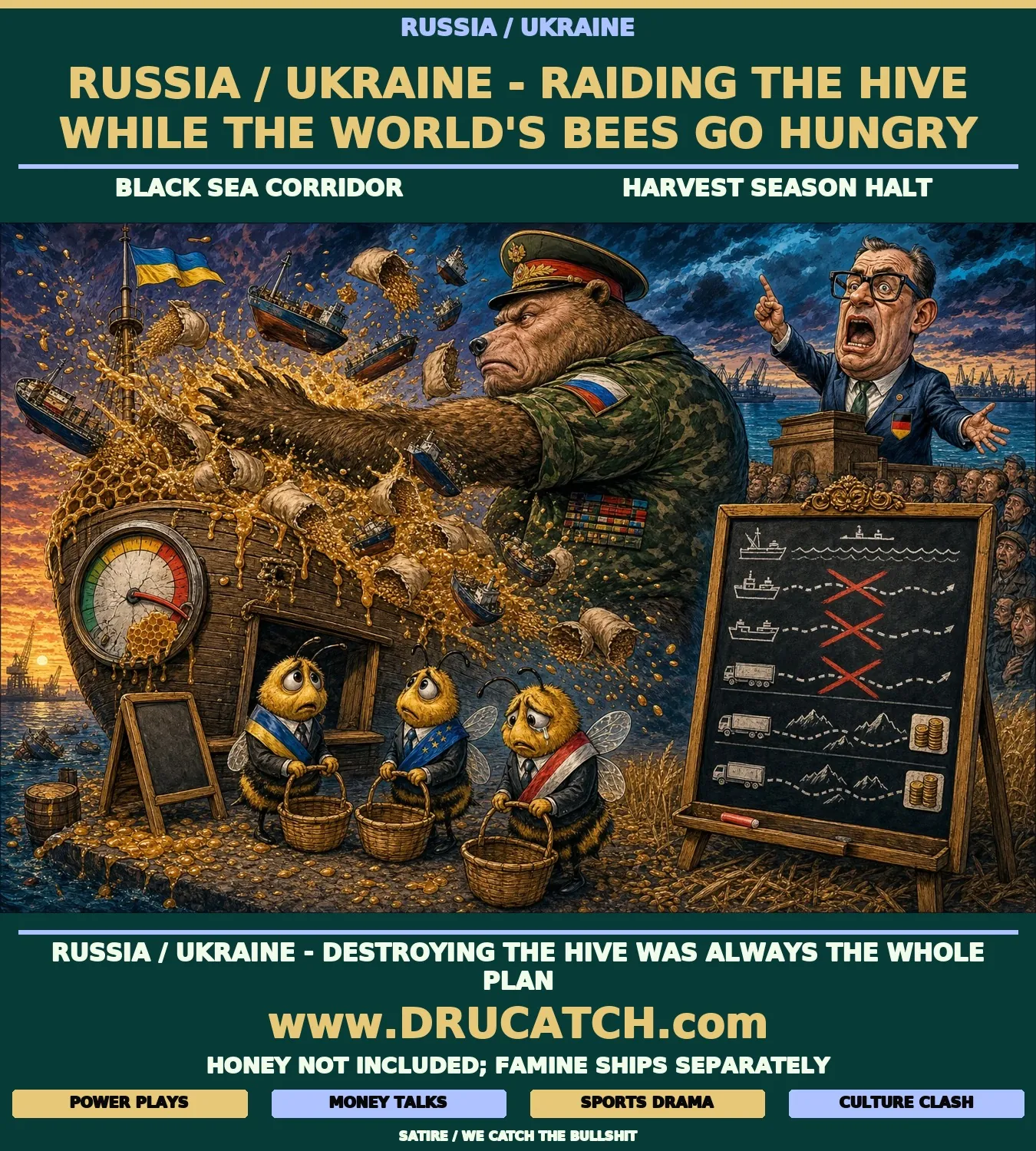
HOW DRU CATCH SEES IT
Russia Is Not Missing the Grain Ships by Accident
Consider the basic geography of the problem. Ukraine ranks among the planet's leading grain exporters, the Black Sea is the main artery that carries those exports outward, and Russia has chosen to sever the artery - not as unfortunate spillover but as deliberate campaign. The targets are cargo vessels, port infrastructure, and ships in the process of loading agricultural goods. Speaking before foreign minister talks in Istanbul on October 23, German Foreign Minister Johann Wadephul made the consequence explicit: interference with shipping lanes across the Black Sea, Red Sea, and Strait of Hormuz is severing the flow of food and fertilizer to countries that cannot grow what they need at home. Wadephul singled out Turkey - the planet's largest processor of wheat - as a nation sitting directly in the path of that disruption. A pressure point that prominent does not get squeezed by accident.
Hitting the Corridor at Harvest Season Is a Choice, Not a Coincidence
The satirical bear-and-beehive framing earns its keep here, because the bear is not interested in eating the honey - it is interested in there being no honey left. Every cargo ship sunk or damaged in the Black Sea functions as a message to every maritime insurer and shipping operator still doing the math on whether that route is worth the risk premium. Euromaidan Press reported that in July, Russian strikes brought traffic through the export corridor nearly to a halt - and that this happened during harvest season. During harvest season. That scheduling is not incidental; it is the mechanism. Grain stacking up at Ukrainian terminals with diminished routes to market squeezes global supply and translates into higher prices absorbed by the countries least positioned to absorb them: importers in the Middle East and across Africa.
The Hostage Was Already Taken Before the Warning Landed
Wadephul situated the Black Sea campaign inside a wider architecture of maritime pressure - Houthi operations in the Red Sea, Iranian leverage over the Strait of Hormuz - and urged governments to collectively signal that global commerce cannot be held to ransom by any of those actors. The difficulty is that the ransom collection is already underway. The cost shows up as food price spikes across the Middle East and Africa, and as fertilizer gaps that will shrink next season's harvests in countries that were already operating on thin margins before the first ship went down. The bear in the cartoon is not unaware that the bees are going without. DruCatch's read: the bees going without is the entire point of the exercise.
THE COMMENTS SECTION HAS ENTERED THE CHAT
If attacking civilian grain shipments is a documented military strategy in the Russia-Ukraine war, at what point does the international community's response - warnings, meetings, statements - become insufficient relative to the scale of the humanitarian consequence?
Join the discussion / save / share