HOW DRU CATCH SEES IT
Grandma Didn't Sign Up for Leveraged Exposure
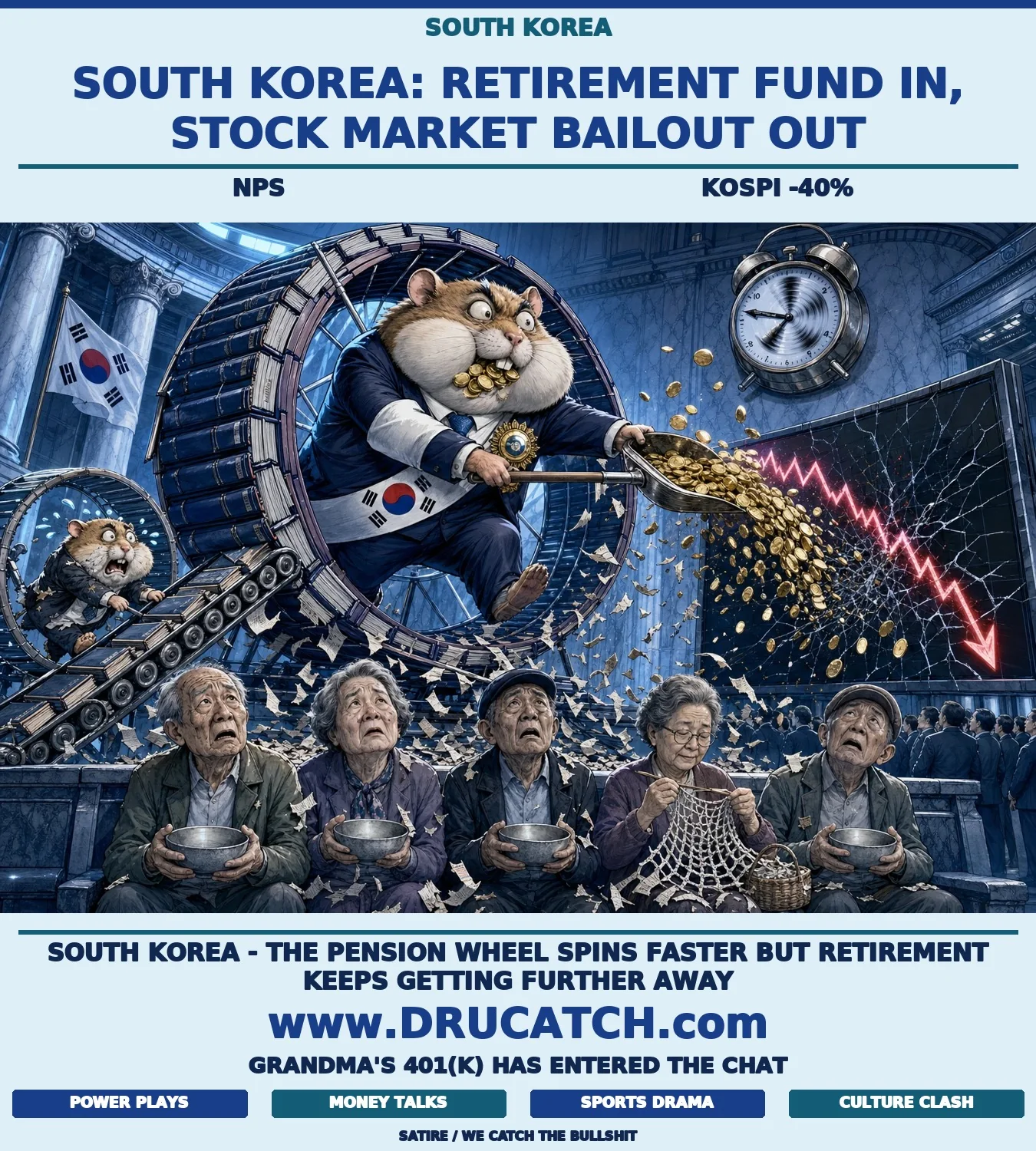
South Korea's retirement piggy bank has a second job it never applied for: stock market cheerleader. The National Pension Service exists, by its own mandate, to safeguard the retirement security of millions of Koreans. It is not, as The Korea Times pointedly notes, "a government instrument for propping up stock prices." Yet the most troubling questions about a market that shed roughly 40 percent of its value in four months land squarely on whether the Lee Jae Myung administration treated the NPS as exactly that - a political fire hose aimed at a financial inferno it may have helped ignite.
Every Retiree Is Now an Involuntary Day Trader
There is a specific breed of institutional absurdity at work here. A pension fund's entire reason for existing is long-term prudence: take contributions, manage risk, pay retirees decades from now. The moment a government treats that fund as a market-stabilization tool, it turns every retiree into an involuntary day trader. Grandma didn't sign up for leveraged exposure to whatever policy experiment crashed the KOSPI 7.57 percent in a single session. She signed up for a pension. The administration's failure to provide convincing answers about its own policy decisions isn't just evasive - it's structurally insane, because the people waiting for those answers are the same people whose retirement savings are collateral damage.
A Loyalty Test with a Forty-Year Payout Horizon
The deeper rot is the incentive structure itself. If the NPS can be leaned on whenever a president needs the market to look healthier than it is, then "investment discipline" becomes a suggestion, not a mandate. The fund's managers aren't choosing between good bets and bad bets - they're choosing between professional judgment and keeping their jobs. That is not a pension system. That is a loyalty test with a forty-year payout horizon, and right now the bill is arriving early.
THE COMMENTS SECTION HAS ENTERED THE CHAT
When a government uses a national pension fund to pursue political market goals, who should be held accountable when retirees' savings evaporate - the politicians who pressured the fund, the fund managers who complied, or the regulatory framework that allowed it?
Join the discussion / save / share