HOW DRU CATCH SEES IT
South Korea Built a Watchdog That Fetches Its Own Fines Back
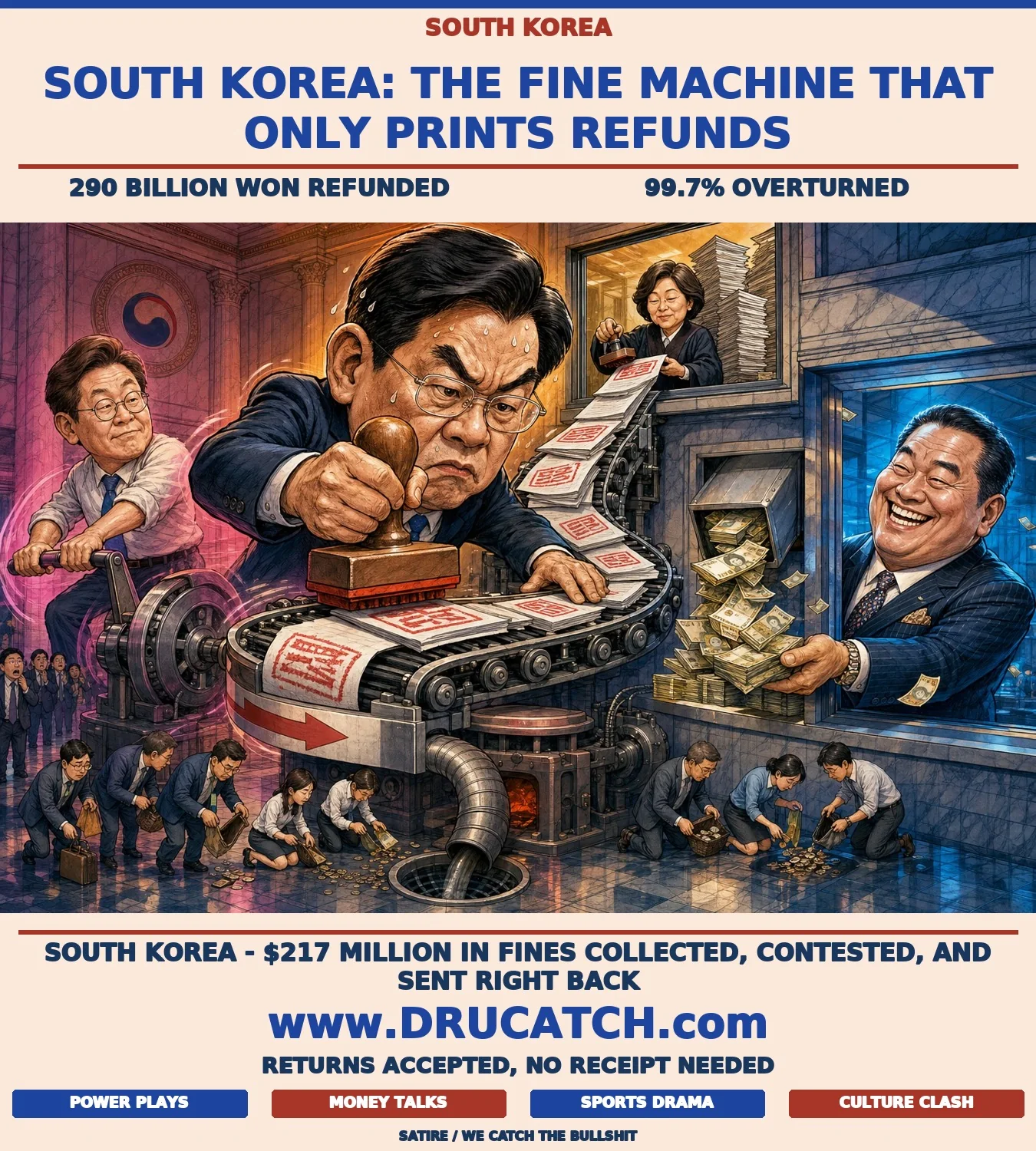
Picture a regulator so enthusiastic about punishment that it forgets to check whether the punishments stick. South Korea's Fair Trade Commission has perfected exactly that model: slap conglomerates with headline-grabbing penalties, wait for the legal challenge, lose in court, then wire the money back. Opposition lawmaker Choi Eun-seok obtained data showing the agency has returned roughly 290 billion won - about $216.7 million - to companies since 2022 after administrative courts reversed its sanctions. Collecting fines only to refund them is not enforcement. It is an involuntary lending programme with zero interest and excellent PR.
When 99.7 Percent of Your Refunds Come From Being Wrong
Here is the statistic that should haunt every South Korean taxpayer: of the 23 billion won the FTC handed back during the first nine months of this year, a staggering 99.7 percent traced directly to sanctions that courts struck down partly or entirely. Strip away the bureaucratic phrasing and you get a regulator whose recent penalty work survives judicial review at a rate that rounds comfortably to zero. At that point the agency is less a market watchdog and more a full-employment programme for administrative-law firms on both sides of the courtroom.
The Government's Fix: Crank the Broken Machine Faster
Rather than pausing to ask why courts keep dismantling its cases, the government under President Lee Jae Myung has moved to beef up the FTC's enforcement toolkit since he took office. The logic is breathtaking: the machine that converts public money into corporate refund cheques apparently just needs more horsepower. Conglomerates, meanwhile, have learned the game perfectly - absorb the fine, hire the lawyers, wait for the court date, collect the refund. Businesses bankroll defence counsel, the FTC bankrolls refund processing, and taxpayers quietly finance both halves of a fight whose only durable output is a press release about cracking down. When the signature product of your regulatory apparatus is a reimbursement receipt, you have not constructed a watchdog. You have staffed a returns counter.
THE COMMENTS SECTION HAS ENTERED THE CHAT
When a regulator's enforcement actions are overturned at a rate of 99.7 percent, should the government strengthen that regulator's powers or reform the way it builds its cases first?
Join the discussion / save / share