HOW DRU CATCH SEES IT
You Jumped Into the Public Arena. The Law Noticed.
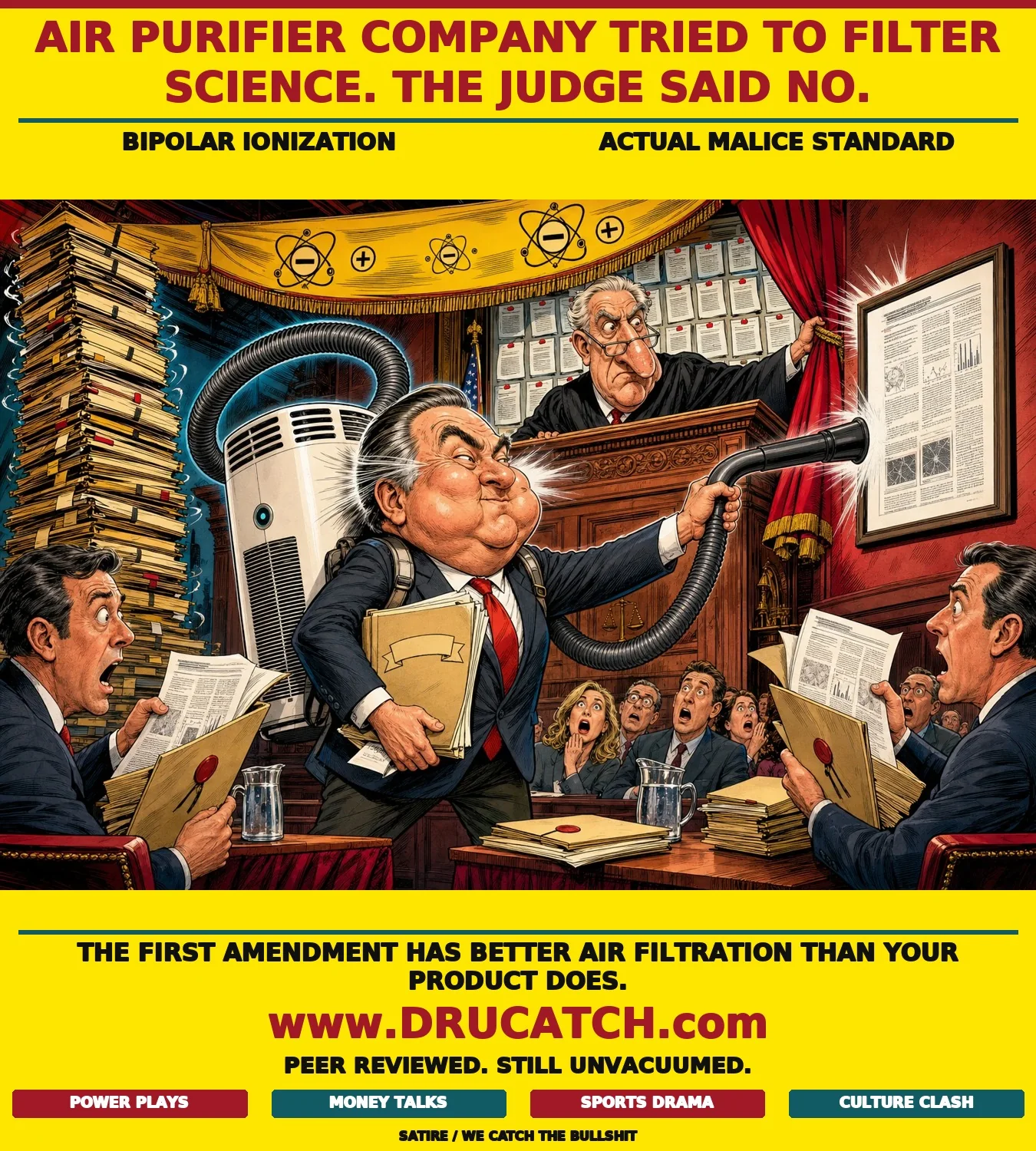
Global Plasma Solutions didn't just sell an air purifier. It sold a product positioned as a COVID-era solution at the exact moment the country was desperate for anything that sounded like protection. That marketing strategy - leaning hard into a public-health emergency - is precisely what turned GPS into what the court called a limited-purpose public figure with respect to the safety and efficacy of its bipolar ionization technology. According to Judge Bell's ruling, as reported by Reason Magazine, that status required GPS to prove actual malice by clear and convincing evidence, meaning it had to show Elsevier knew the article was false or acted with reckless disregard for the truth. GPS could not do it.
The court noted that the alleged conduct - while in several respects falling well short of being fabricated or fraudulent data, in the judge's own phrasing - might possibly have justified limiting full First Amendment protection for scientific opinion. But the court didn't even need to go there. GPS lost on actual malice alone. The takeaway is uncomfortable for any company that uses a public crisis to build a brand: the louder you speak during a national emergency, the harder the law makes it to silence your critics.
Calling an Article 'Peer Reviewed' Is Not False Advertising
GPS had a second theory: that Elsevier's promotion of the Building and Environment article as 'peer reviewed' constituted false advertising under the Lanham Act. The court rejected this, too. Per the ruling, there was insufficient evidence that a substantial portion of the intended audience would be misled by that truthful statement, and no adequate showing that an Elsevier advertisement was the proximate cause of GPS's claimed drop in corporate value.
This is a remarkable argument to have litigated for four and a half years. The claim essentially asked a federal court to find that accurately describing the peer-review process to an academic readership was deceptive. Whatever one thinks of peer review's imperfections - and scientists debate them constantly - the mechanism for policing those imperfections is more scientific debate, not Lanham Act litigation. The court, politely but firmly, said the same thing.
Confidential: This Press Release We Already Sent Everyone
Appended to the substantive ruling was something the judge apparently couldn't let pass without comment. Both parties, the court found, had excessively filed memoranda, documents and exhibits under seal in violation of the strict legal principles applicable to publicly filed motions. The governing First Amendment standard requires that any denial of public access to court records be necessitated by a compelling interest and narrowly tailored to serve that interest. The parties, the court noted with the word 'incredibly,' had sealed press releases and other obviously public documents.
The judge ordered virtually the entire sealed record refiled publicly on a tight schedule, with only narrow exceptions. So the final shape of this litigation looks like this: a company sued a scientific journal for too much damaging information reaching the public, while simultaneously trying to keep its own publicly issued documents out of the public court record. A federal judge ruling in favor of open scientific discourse then had to separately rule in favor of open court records. Both lectures were necessary. Both were earned.
THE COMMENTS SECTION HAS ENTERED THE CHAT
Should companies that promote health-related products during a public emergency face a higher First Amendment burden when trying to silence scientific critics - or does the "limited purpose public figure" standard already strike the right balance?
Join the discussion / save / share