HOW DRU CATCH SEES IT
A $2 Billion Blind Spot in the Most Regulated Healthcare State in America
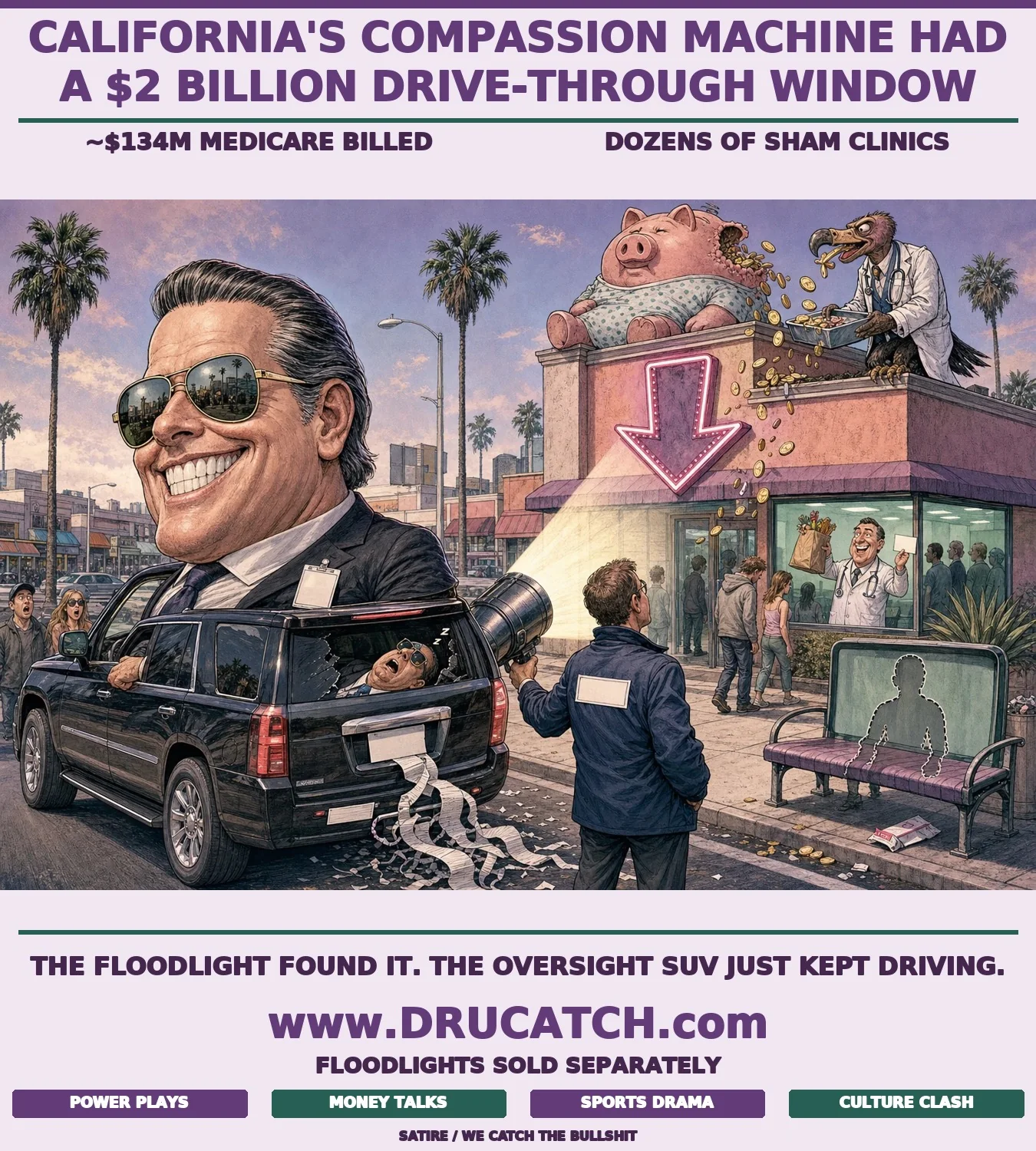
California has spent years positioning itself as the gold standard of compassionate, regulated, safety-net governance. It has more healthcare bureaucracy per square mile than most countries - task forces, oversight bodies, commissions, and a regulatory apparatus so thick you could use it as structural insulation. And yet, according to federal investigators, someone allegedly ran a $2 billion fraud operation through hospitals, rehab clinics, hospices, and pharmacies, in plain sight, for years.
The alleged mechanics are breathtaking in their mundane cruelty. Patients allegedly lured into fake arterial disease diagnoses with grocery bags and $50 gift cards. Homeless people and addicts allegedly trafficked into sham rehabilitation centers that billed insurers for treatment never delivered - sometimes, the allegation goes, with drugs offered as the recruitment pitch. When the insurance money ran out, the article claims, operators dropped addicts on the street, contributing, per the New York Post opinion piece, to the very homelessness crisis the state claims to be fighting.
One Federal Prosecutor Found What Dozens of State Agencies Apparently Missed
The New York Post opinion piece attributes the crackdown to First Assistant U.S. Attorney Bill Essayli, crediting him as an 'energetic federal prosecutor' willing to act where California's state leadership allegedly did not. The piece claims fraud in California is so abundant Essayli 'doesn't need a flashlight to find it - he can use a floodlight.' That is either a devastating indictment of state oversight or a politically motivated frame - probably both, given the source. Either way, the underlying federal action is real, the alleged scale is $2 billion, and the state's vast regulatory machine is not the one that found it.
DruCatch notes the opinion piece carries a clear political agenda: it credits President Trump with placing Essayli in the role and claims Democrats 'silenced' him in Sacramento, offering no supporting detail for either assertion. Readers should treat the political framing as editorial opinion. The factual allegations about the investigation, however, stand on their own and raise a legitimate question: if the article's claim that state leaders were aware of the phony rehab pattern is even partially accurate, what exactly were the relevant agencies doing while $134 million in allegedly unnecessary surgeries was being billed to Medicare?
The $50 Gift Card Is the Whole Story
The detail that makes this allegedly real and not a Netflix pitch is the $50 gift card. Two billion dollars of alleged fraud, and the entry price for a vulnerable patient was a bag of groceries and a prepaid debit card. That is not sophisticated criminal genius requiring invisible infrastructure. That is a system so structurally indifferent to the people it nominally protects that almost nothing was needed to exploit them.
The rhetoric of compassionate governance and the alleged reality of monetized suffering are not a subtle contradiction. They are a $2 billion one, spread across surgery suites, fake rehab waiting rooms, hospice billing departments, and pharmacy counters - all allegedly humming along until a single federal office decided to look. The lesson California's regulatory establishment may prefer to skip: a floodlight only works if someone is willing to turn it on.

THE COMMENTS SECTION HAS ENTERED THE CHAT
If federal allegations about California's $2 billion medical fraud ring prove accurate, what does it say about the relationship between a state's stated commitment to healthcare regulation and its actual capacity - or willingness - to enforce it? Is the gap between regulatory rhetoric and oversight reality a California-specific failure, or a systemic one?
Join the discussion / save / share