HOW DRU CATCH SEES IT
The Score That Broke the Curve
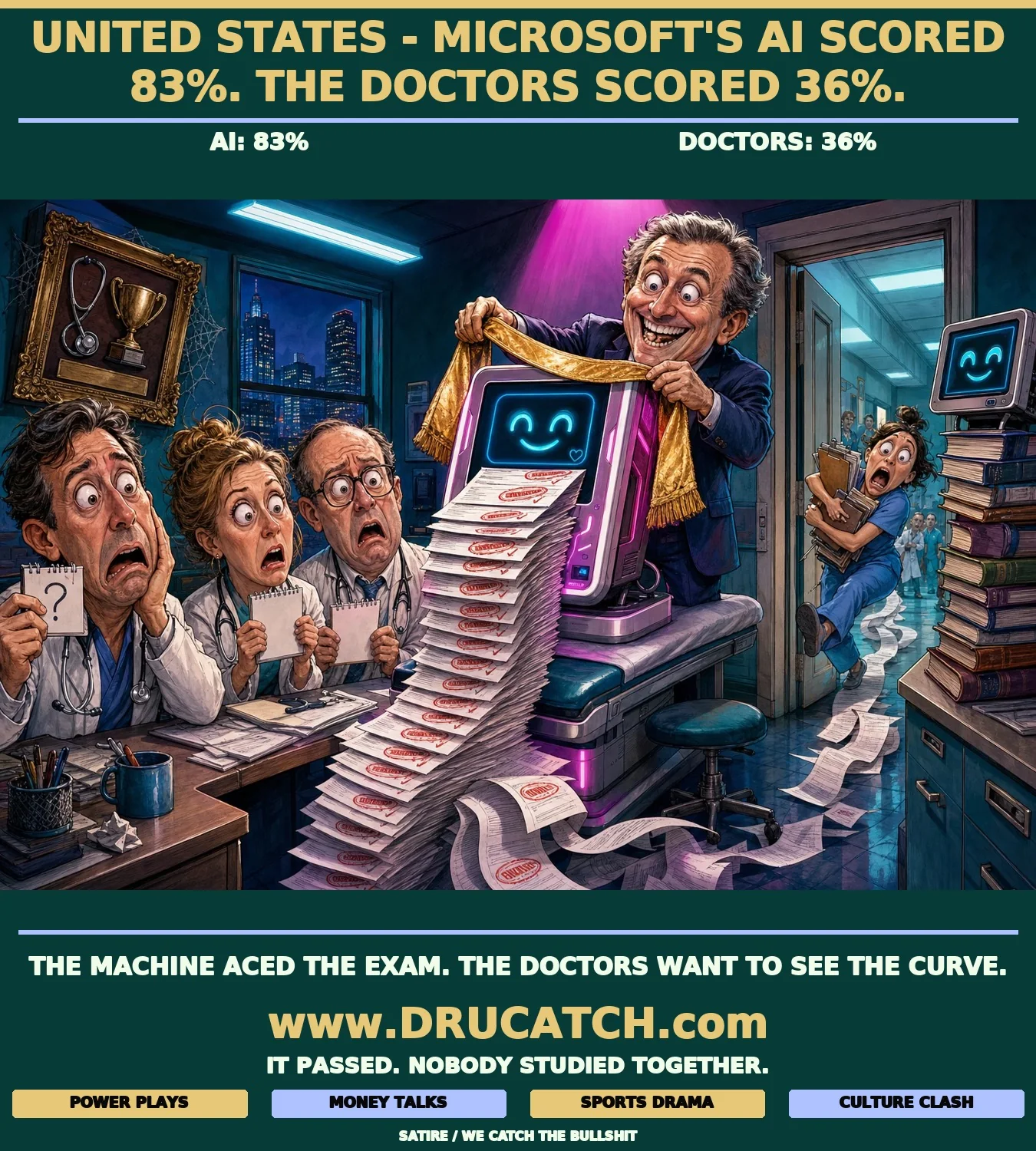
Microsoft's AI Diagnostic Orchestrator, MAI-DxO, scored 83% on 304 complex medical cases drawn from the New England Journal of Medicine - the kind of cases that appear in that journal specifically because they stumped people. General practitioners with access to reference manuals scored 36%. Without those resources, they scored 22%. That is not a close race. That is the AI lapping the field.
The system does not just match symptoms to conditions. It works the way a thorough doctor is supposed to: asking about history, ordering targeted tests, reassessing when results come back, and flagging when more information is needed. An 'orchestrator' mechanism coordinates several virtual specialist perspectives to reach the most likely diagnosis while avoiding unnecessary testing. Microsoft says the approach also held estimated investigation costs to roughly half those of comparison systems in certain experimental setups - though those savings exist only in simulations so far.
What the Study Cannot Tell You
Every score this impressive comes with an asterisk worth reading. The 304 cases were published medical puzzles - difficult by design, pre-packaged with all relevant information already organized. In an actual emergency department, patients show up with incomplete symptoms, contradictory histories, unexplained rashes and a strong reluctance to admit they stopped taking their medication. The AI requested information from an existing dataset. Real medicine involves coaxing that information out of a frightened person in a curtained bay.
Dominic King, vice president of Microsoft's AI health division, made this point directly, which is an unusual degree of self-restraint for a company announcing a milestone result. The technology has not been validated for autonomous hospital diagnosis. The Boston trial with Beth Israel Deaconess Medical Center is specifically designed to test whether MAI-DxO can support triage in a live emergency department without compromising patient safety - an outcome nobody involved is treating as guaranteed.
The Stethoscope in the Room
The honest tension here is not whether AI will replace doctors tomorrow - Microsoft's own team says it won't and isn't trying to. The real question is what happens to the medical profession's diagnostic authority when a software system, trained on published cases and tuned for careful sequential reasoning, can reliably outscore general practitioners on the hardest available tests. The answer probably isn't replacement. It is almost certainly recalibration.
Harsha Nori from Microsoft AI Health framed the research goal as evaluating both diagnostic correctness and the cost-justification of investigations. That framing matters: this is not just about being right, it is about being right efficiently. If MAI-DxO can maintain 81% accuracy at half the investigation cost in simulation, the economic argument for deploying it in some capacity will outlast any squeamishness about bedside manner. The stethoscope is not going anywhere. But it may get a very expensive co-pilot.
THE COMMENTS SECTION HAS ENTERED THE CHAT
If an AI system can outperform doctors on complex diagnostic accuracy under test conditions, what should the realistic role of AI be in clinical medicine - decision support tool, triage assistant, or something more disruptive? And who decides?
Join the discussion / save / share