HOW DRU CATCH SEES IT
The Testimonial That Accidentally Confessed Everything
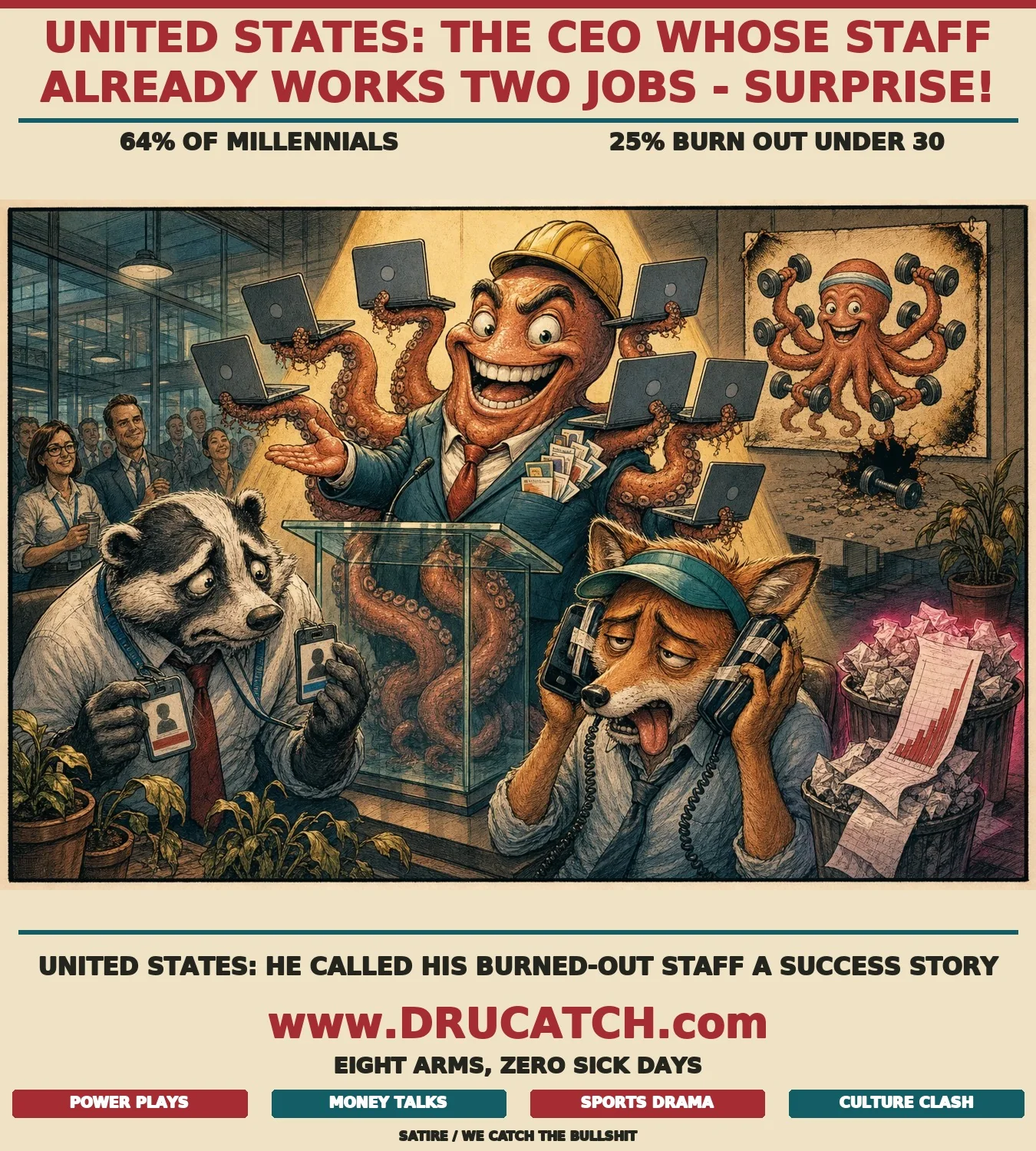
Yakov Filippenko, CEO of Intch - a platform that matches professionals to part-time roles - commissioned a study showing parallel work has doubled across generations, then offered his own team as the flagship case study. His head of HR holds a full-time role at a separate tech company. His head of payments operates under an identical arrangement. Both are, he told Fast Company, completely open about it. Filippenko relayed this information as though it were a brand asset rather than a staffing disclosure.
A specific brand of confidence is required to position your own workforce as living proof of a trend you are actively monetizing - and then note, in the same breath, that 64% of millennials and 59% of Gen Zers are doing exactly this, and that a quarter of workers hit burnout before their 30th birthday. Filippenko has constructed a platform for distributing people across multiple employers at once and has somehow sidestepped the obvious follow-up: who is minding the workers sandwiched between all those arrangements?
Freedom Is What You Call It When Someone Else Is Juggling
To be fair to Filippenko, parallel work is not invented cruelty - it is a documented response to documented financial strain. A 2025 Fiverr survey found 67% of Gen Zers report needing more than one income source to stay solvent, and more than half expect single-employer careers to become a historical curiosity. That is not a career philosophy. That is arithmetic. When one job no longer covers rent, a second job follows, and somewhere downstream a LinkedIn thought leader rebrands the whole arrangement as a portfolio strategy.
Filippenko does land one genuinely useful observation: a résumé stacked with overlapping roles should no longer be decoded as evidence of unfocused wandering. The Intch research suggests simultaneous positions may signal professional depth rather than chronic drift. Fine. But there is a considerable distance between reframing how a hiring manager reads a CV and celebrating the underlying economic conditions that made the CV look that way in the first place.
The Burnout Number Is Not a Footnote - It Is the Point
Near the end of the Fast Company piece sits the detail that carries the most weight: a 2025 poll of 2,000 adults found a quarter of workers reporting burnout before age 30. The same generation most energetically - or most necessarily - working concurrent roles is also the generation flaming out earliest. The Intch study is built on 1.05 million career roles. The burnout poll accounts for the people those roles belong to. One document narrates a growth story. The other itemizes what that growth is extracting.
Parallel work will keep expanding. The economic pressures that pushed the share of professionals changing jobs while already employed from 68% in 2019 to 73% in 2025 have not softened. But a CEO who converts his own multi-jobbing, visibly stretched staff into a product demonstration - without pausing to ask whether the model holds up - has not identified an opportunity. He has identified a symptom, applied a coat of optimism, and invoiced it as a feature.
THE COMMENTS SECTION HAS ENTERED THE CHAT
When a CEO publicly celebrates his employees holding two full-time jobs simultaneously as a feature rather than a warning sign, what responsibility does company leadership have to consider whether that model is sustainable - or is financial pressure on workers simply rebranded as professional freedom?
Join the discussion / save / share