HOW DRU CATCH SEES IT
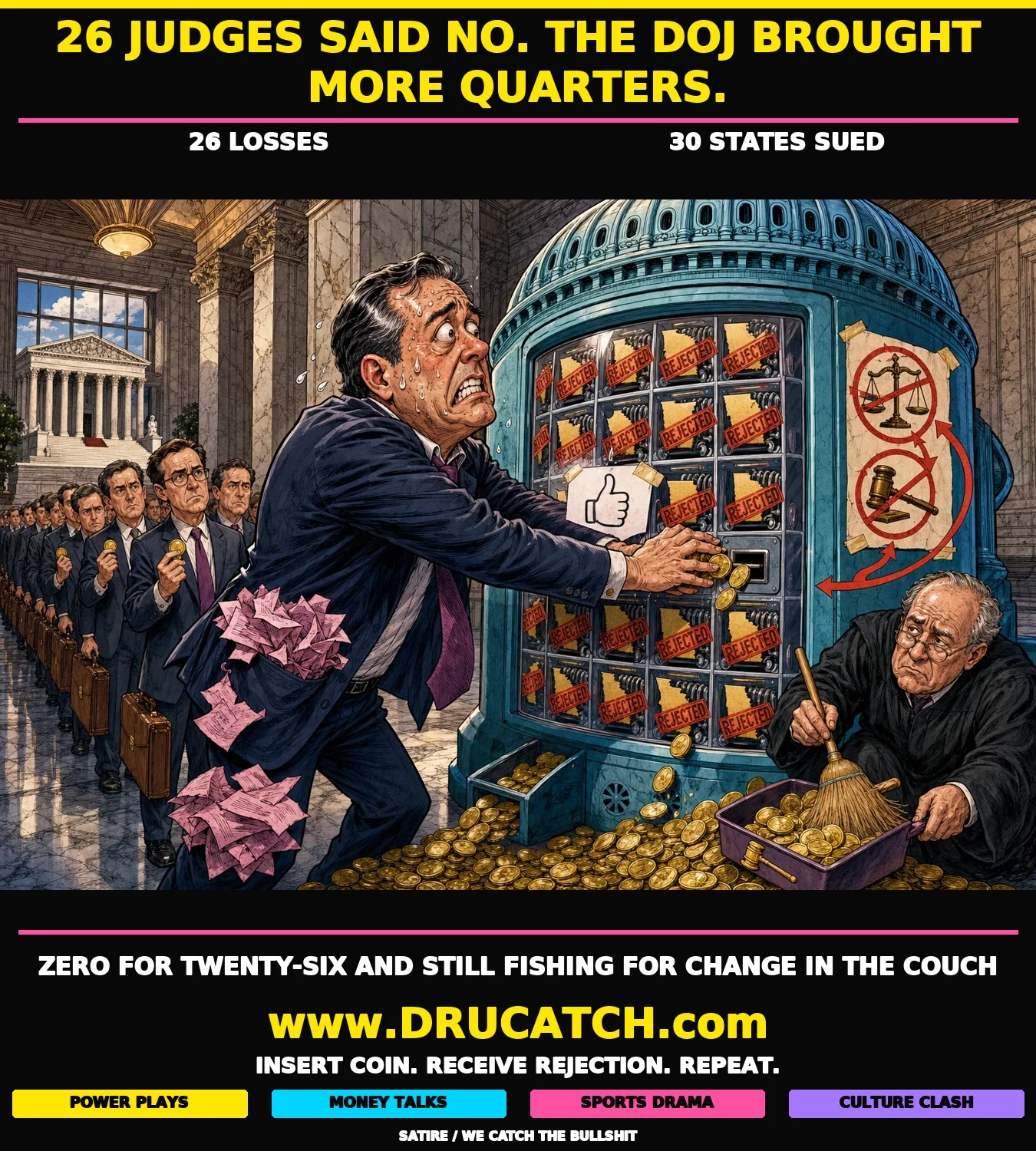
Twenty-Six Judges Said No. The DOJ Brought More Coins.
The Department of Justice sued 30 states for their unredacted voter rolls and lost 26 consecutive rulings from a bench that included judges appointed by Trump himself, by George W. Bush, and by two Democratic presidents. That is not a rough patch. That is a documented institutional refusal to absorb information. When a Maine federal judge - a Trump appointee - describes the government's legal arguments as 'halfhearted' and a West Virginia judge - a Bush appointee - calls the demand 'devoid of any factual basis,' the problem is not a hostile judiciary. The problem is the case.
The DOJ's official position is that its lawyers argue 'honestly and in good faith' and that losing is not evidence of bad faith. Fine. But 0-for-26 is not a philosophical disagreement about election law. It is a unanimous verdict from a randomly assigned cross-party sample of the federal bench, and the verdict is: you have no legal basis. The administration's plan is to appeal everything and possibly escalate to the Supreme Court - which, at this trajectory, is less a legal strategy than a loyalty test for whoever sits at the top.
Follow the thread: United States: Trump's Female Hires Were the Shield. Now the Shield Is Walking Out..
When Your Civil Rights Argument Runs Backwards
The second wave of lawsuits reached for a 1960 Civil Rights Act provision - Title III - designed to stop Southern election officials from destroying records that proved Black voters had been unlawfully purged. That law was built to expose suppression. The DOJ tried to run it in reverse, claiming it gave the attorney general 'sweeping power' to vacuum up voter data from every state. The D.C. federal judge who heard that argument quoted the actual history back at the government with what can only be described as judicial incredulity.
A Maryland judge - a Trump appointee - identified a structural problem so clean it almost writes itself: the DOJ's reading of Title III would make criminal the very conduct that federal voting laws actively require. The agency managed to construct a legal argument that is internally contradictory, historically backwards, and, per 19 separate judges, wrong. That takes a particular kind of commitment.
The Office That Protects Voting, Doing the Other Thing
The unit bringing all 30 of these lawsuits is the Civil Rights Division - the office historically tasked with protecting the right to vote. Per multiple judges on record, it has been using civil rights statutes as a pretext to build a national voter database and advance what a Pennsylvania judge called a 'fishing expedition' for noncitizen voting, with unsubstantiated claims as its only catch. The Oregon federal judge went further, writing that the DOJ had burned through the judiciary's longstanding presumption that the government could be taken at its word. That presumption, he said, 'no longer holds.'
Four cases are still live. The administration is appealing most of its losses. The only appellate ruling so far - from the Sixth Circuit in the Michigan case - backed the district judge who threw it out. The DOJ says it looks forward to making its case on appeal. After 26 dismissals, that is either extraordinary confidence or the legal equivalent of a guy who gets tossed from 26 bars and starts researching whether the city council has a complaints process.




THE COMMENTS SECTION HAS ENTERED THE CHAT
When a government agency loses 26 consecutive lawsuits on the same legal theory, at what point does "we'll appeal" stop being persistence and start being taxpayer-funded stubbornness?
Join the discussion / save / share