HOW DRU CATCH SEES IT
Paradise: Discovered by the People Who Built the Deficit
Argentine politics runs on a specific kind of amnesia - not the forgetting kind, but the curated kind, carefully irrigated with campaign money and harvested every election cycle. The same political movement that ran state companies as employment agencies for party militants, froze utility tariffs to simulate cheap abundance and left Enarsa bleeding the equivalent of US$1,927 million annually is now heading into the 2027 campaign insisting that 2023 was practically paradise. The evidence supplies the actual 2023 figures: 211% annual inflation, 42% poverty, GDP down almost 2%, investment down 11% and public debt up US$160 billion. That is not a paradise. That is a country being handed over in a body bag with a party balloon tied to the handle.
The evidence notes that no leader of Kirchnerism has publicly apologized for 16 years of state-company mismanagement across four administrations. Not an apology for the excess staffing used to absorb party militants. Not for the "ridiculously low political tariffs" subsidized entirely by the Treasury. Not for the deficits that the source describes as fueling both public debt and the inflationary tax that hit the poorest Argentines hardest. The 2027 campaign strategy appears to be: install a different story before voters do the arithmetic.
The Numbers That Arrived Without an Apology
Enarsa's ordinary economic deficit fell from the equivalent of US$1,927 million in 2023 to a projected US$393 million in 2026 - a reduction of roughly 80% - according to the company's own figures cited in the source. Its dependence on Treasury transfers dropped from 107.2% to a projected 17.6%. Correo Argentino stopped requiring Treasury assistance from November 2024, posted net profits in 2025 and generated positive operating cash flow of more than $228 billion pesos. These are not government press releases dressed as journalism; these are the company's published financial statements.
The mechanism behind these improvements is precisely what the opposition refuses to name. The source is explicit: the tariff increases that now impose a real sacrifice on a large part of the Argentine population are a direct consequence of the previous government's deliberate freezing of rates to stimulate consumption. Enarsa's collection rate jumped from 30% to 90% once market-rate adjustments were implemented. Correo restructured its logistics, developed a franchise network and invested in AI-automated sorting. None of this required a new political slogan. It required undoing the last several years of management.
The Invoice and Who Signs It - and Who Pretends They Never Ordered
The source also raises a legitimate counter-point worth keeping: the Milei government has its own communication failures around the magnitude and pace of tariff adjustments, and the famous Cardoso principle - 'to govern is to explain' - applies in both directions. Fixing a broken system without explaining the repair to the people absorbing the cost is its own political failure.
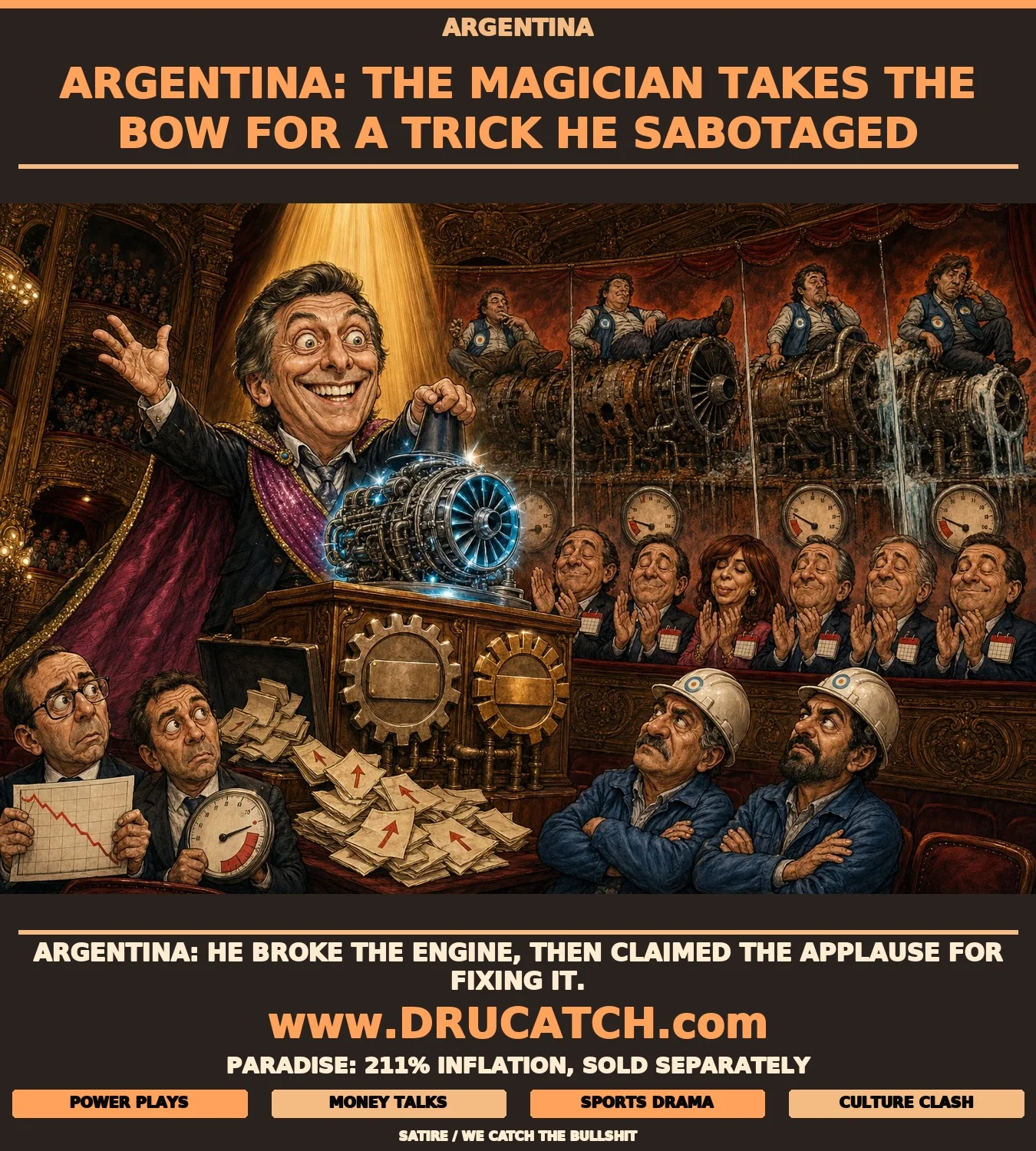
But the structural absurdity remains untouched: the party that created the debt is running against the invoice. Argentines paying higher utility bills are, per the evidence, paying the deferred cost of the freeze their previous government used to manufacture the illusion of cheap prosperity. The magician did not pull the turbine from a hat. The engineers fixed it in the dark while the magician rehearsed his bow. Enarsa and Correo Argentino did not fix themselves during a paradisiacal era. They fixed themselves after one.
THE COMMENTS SECTION HAS ENTERED THE CHAT
When state-company deficits disappear after years of political mismanagement, who deserves credit - the government that finally fixed the incentives, the companies that executed the turnaround, or the consumers who absorbed the tariff increases that made it possible?
Join the discussion / save / share