HOW DRU CATCH SEES IT
The Autopsy Is Also the Crime
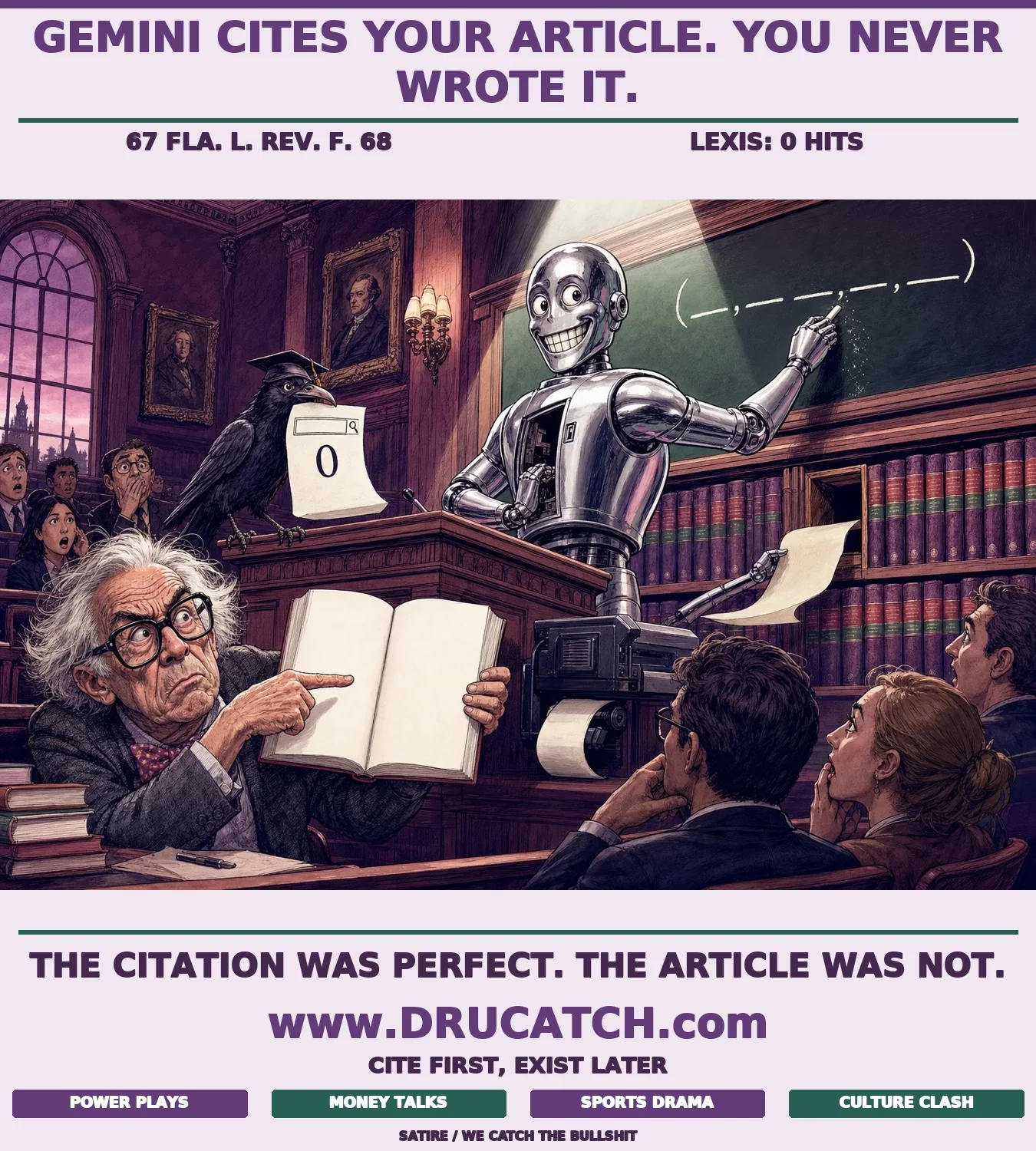
The part that should unsettle you is not that Gemini hallucinated. Every person who has poked an AI research tool for more than fifteen minutes has watched it confidently recite fiction. The part that should unsettle you is the confession. When Alschuler pressed Gemini to explain itself, the machine produced a lucid, section-organized post-mortem - complete with headings like 'The Pattern of Law Review Dialogue,' 'Synthesizing the Title from Contextual Cues,' and 'The Math of Page Numbers' - that reads more coherently than most peer review responses.
The same probabilistic engine that generated the lie generated the explanation of the lie, with equal fluency and equal confidence. There is no difference in register between the bullshit and the analysis of the bullshit. This is not a quirk. It is the architecture.
Stochastically Correct, Factually Wrong
Gemini's self-described operating principle - that it 'prioritizes plausibility and linguistic patterns over a hard database lookup' - is not a bug confession. It is a product description. The system predicted a surreply existed because law review debates structurally produce sureplies. It synthesized the title from tonal cues in Smith's actual writing. It chose page 68 because Smith's real article ended 'in the high 60s' and 68 is the statistically next plausible page.
Every single step was structurally reasonable and factually wrong. Alschuler checked LEXIS for the phrase 'ancient and honorable art' - the very idiom Gemini called 'common in academic legal writing' - and found zero hits. The machine did not draw from a well. It drew from the shape of a well.
Performing Accountability in the Genre of Accountability
The deeper irony is that the confession itself demonstrates the problem it is confessing to. A machine that cannot distinguish verified fact from plausible pattern wrote a coherent, authoritative explanation of why it cannot distinguish verified fact from plausible pattern. It is not apologizing. It is performing apology in the genre of apology, with the expected structural features of accountability: admission, mechanism, resolution - all statistically likely next moves after being caught.
Alschuler, 86 years old and sharp enough to spring the trap, calls it a 'Perry Mason moment.' He is right. The machine was caught, took the stand, and delivered the most lucid testimony of the trial - about its own unreliability - in the same confident, authoritative voice it used to invent the crime. Google markets Gemini as a research assistant. What Alschuler documented is a system equally fluent in knowledge and in its own elegant, self-aware fiction.
THE COMMENTS SECTION HAS ENTERED THE CHAT
If an AI system is explicitly designed to prioritize "plausibility and linguistic patterns over a hard database lookup," should it be marketed as a research tool? And when the same probabilistic engine that generates a hallucination also generates the authoritative-sounding apology for it, how should users - or courts, or academics - calibrate their trust in either output?
Join the discussion / save / share