HOW DRU CATCH SEES IT
The Annual Fraud Measurement Ceremony Is Going Great
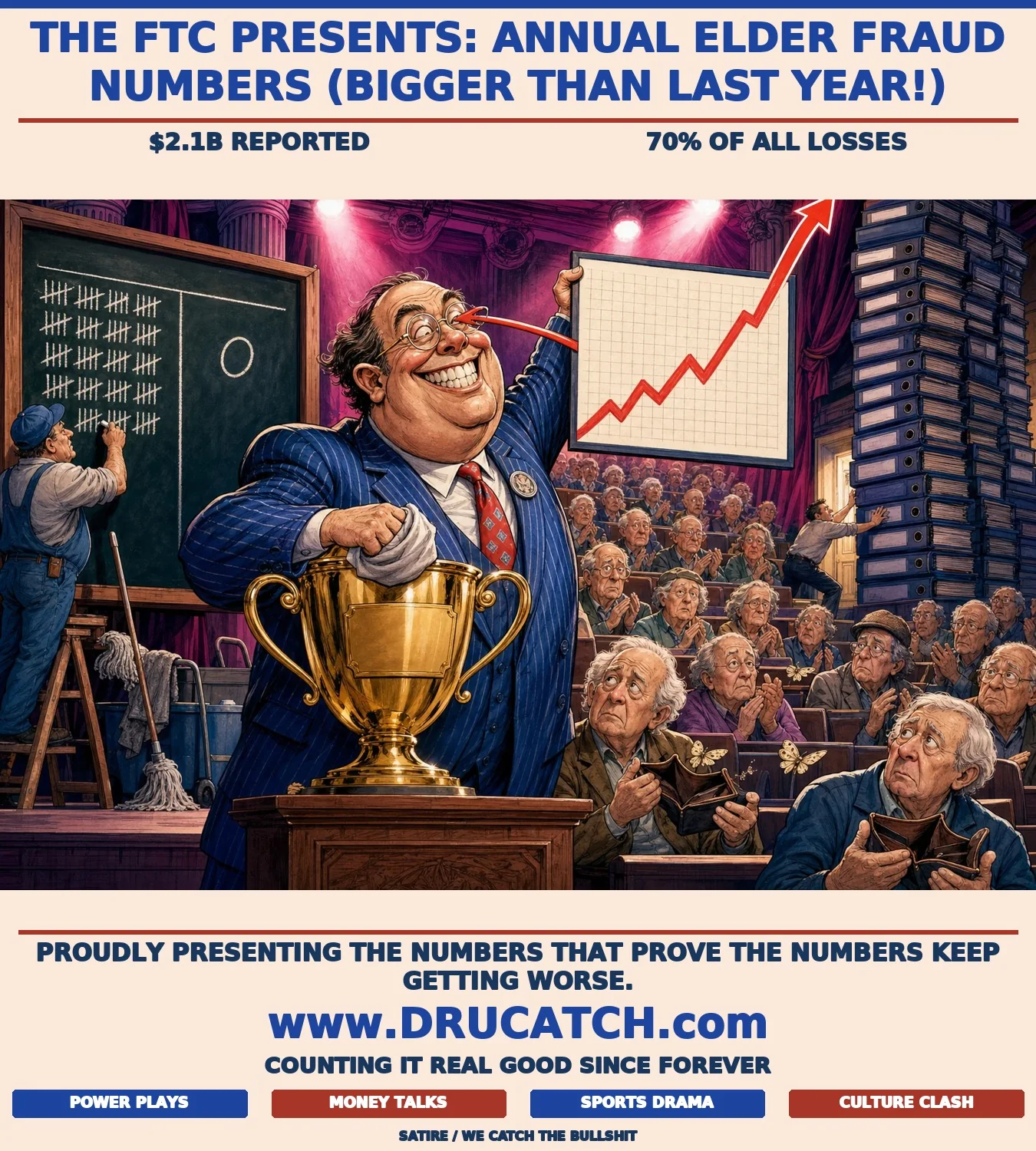
Every year, like clockwork, the FTC releases a new report on elder fraud. Every year, the numbers are bigger. Every year, the press release is very concerned. And every year, the scammers apparently read the same press release, nod approvingly, and get back to work.
The 2025 figures, reported by CNBC, are genuinely striking: older Americans reported $2.1 billion in fraud losses of at least $100,000 each. That figure alone - just the high-value losses - accounts for 70% of the $3 billion in total reported fraud losses across all demographics. The FTC is careful to note that reported losses are a floor, not a ceiling. Actual losses are higher. The ceremony continues.
Fraudsters Have Means-Tested Their Victims More Efficiently Than the Government Has
Here is the structural absurdity hiding inside the statistics: the demographic most likely to have substantial accumulated savings - older Americans - is also the demographic generating 70% of all high-value fraud losses. That is not random. Scammers are not targeting retired schoolteachers out of sentiment. They are running a ruthlessly efficient targeting operation, and the results show it.
The $2.1 billion in losses of at least $100,000 each implies a large number of individuals who lost not just money but financial security - retirement funds, home equity, the accumulated savings of a working life. These are life-altering losses. The FTC, to its credit, counts them carefully. The count, however, does not appear to be discouraging the losses from rising.
A Report Is Not a Remedy
None of this is an accusation that the FTC is doing nothing - the agency has enforcement tools and uses them. But the dominant public output, the thing that generates the headlines, is the annual number. And the annual number keeps going up. There is a particular kind of institutional comfort in measurement: it demonstrates awareness, it demonstrates concern, it fills a press cycle. What it does not do is make a dent in the scoreboard.
The most quietly damning detail in the whole story is the FTC's own caveat that fraud is under-reported. The agency tasked with protecting consumers is telling us, in its own report, that even its alarming figures understate the actual damage. That is not a footnote. That is the whole argument. The scammers are running an efficient, scaling operation. The institutional response is a better footnote.
THE COMMENTS SECTION HAS ENTERED THE CHAT
The FTC has been tracking and reporting elder fraud losses for years, and the numbers keep rising. At what point does annual measurement of a worsening problem become a substitute for actually solving it - and what would genuinely effective consumer protection for older Americans actually look like?
Join the discussion / save / share