HOW DRU CATCH SEES IT
The Boy Who Cried 'Fake' Finally Found One
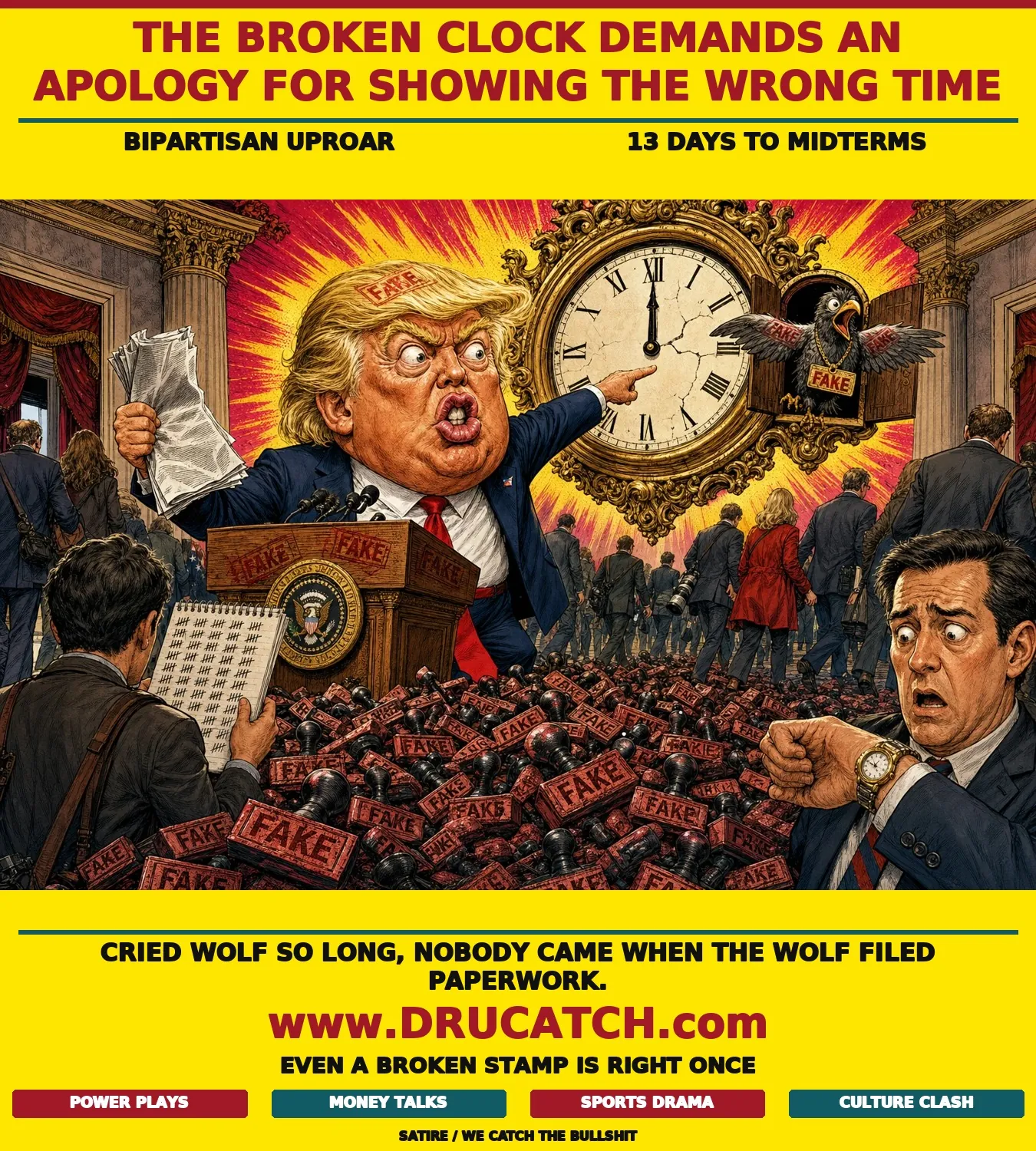
Here is the specific flavor of broken-clock hell we now live in: a president who has called accurate reporting 'fake news' so many times that the phrase has essentially lost its tensile strength is now demanding an apology from The New York Times for polls that are, according to the reporting, actually fraudulent. The boy who cried wolf finally spotted a real wolf. Nobody came running.
The rhetorical problem is entirely self-inflicted. Trump spent years attaching 'fake' to any coverage he didn't like - unfavorable approval ratings, legitimate investigative pieces, election results - until the label became decorative. So when something disputed as genuinely fraudulent turns up, he has to make the same demand in the same voice using the same vocabulary, and the audience's reflex is already trained to scroll past it. He broke his own alarm, and now the house might actually be on fire.
Being Right Twice a Day Requires the Clock to Still Be Trusted
The deeper problem is that 'fake news' as a rhetorical weapon only works in one direction. It was always designed to cast doubt - on accurate reporting, on unfavorable numbers, on institutional credibility Trump found inconvenient. What it was never designed to do is function as a reliable quality-control signal, because that would require it to be used selectively. It wasn't.
So now we have the Times, a paper with genuine credibility problems it has created for itself over years of political coverage decisions, potentially sitting on an apology it may actually owe - and a president demanding that apology with a credibility deficit so vast that even a bipartisan uproar over the same disputed polls, per prior reporting, can't fully rescue the signal from the noise he personally created.
Thirteen Days Out: Convenient Doesn't Mean Wrong
What makes this episode particularly difficult to parse is the timing. Thirteen days before competitive midterm elections, a demand for a press apology over polling errors is not purely a good-faith media accountability exercise. It is also, conveniently, a mechanism for muddying the electoral information environment at the exact moment voters are deciding how much stock to put in any numbers at all.
Convenient and correct are not mutually exclusive. The polls may well have been fraudulent - the bipartisan acknowledgment in prior reporting suggests this is not solely a partisan talking point. But Trump's inability to separate legitimate outrage from tactical noise means the demand arrives pre-discounted, and he has no one to blame for that depreciation but himself. The broken clock shows the right time. The audience already left.
THE COMMENTS SECTION HAS ENTERED THE CHAT
When a politician has applied the same "fake" label to both genuinely false reporting and accurate reporting they disliked, is it still possible for their media criticism to be taken seriously - and whose responsibility is it to rebuild that credibility?
Join the discussion / save / share