HOW DRU CATCH SEES IT
The Administration Found a Way to Not Quite Promise Anything
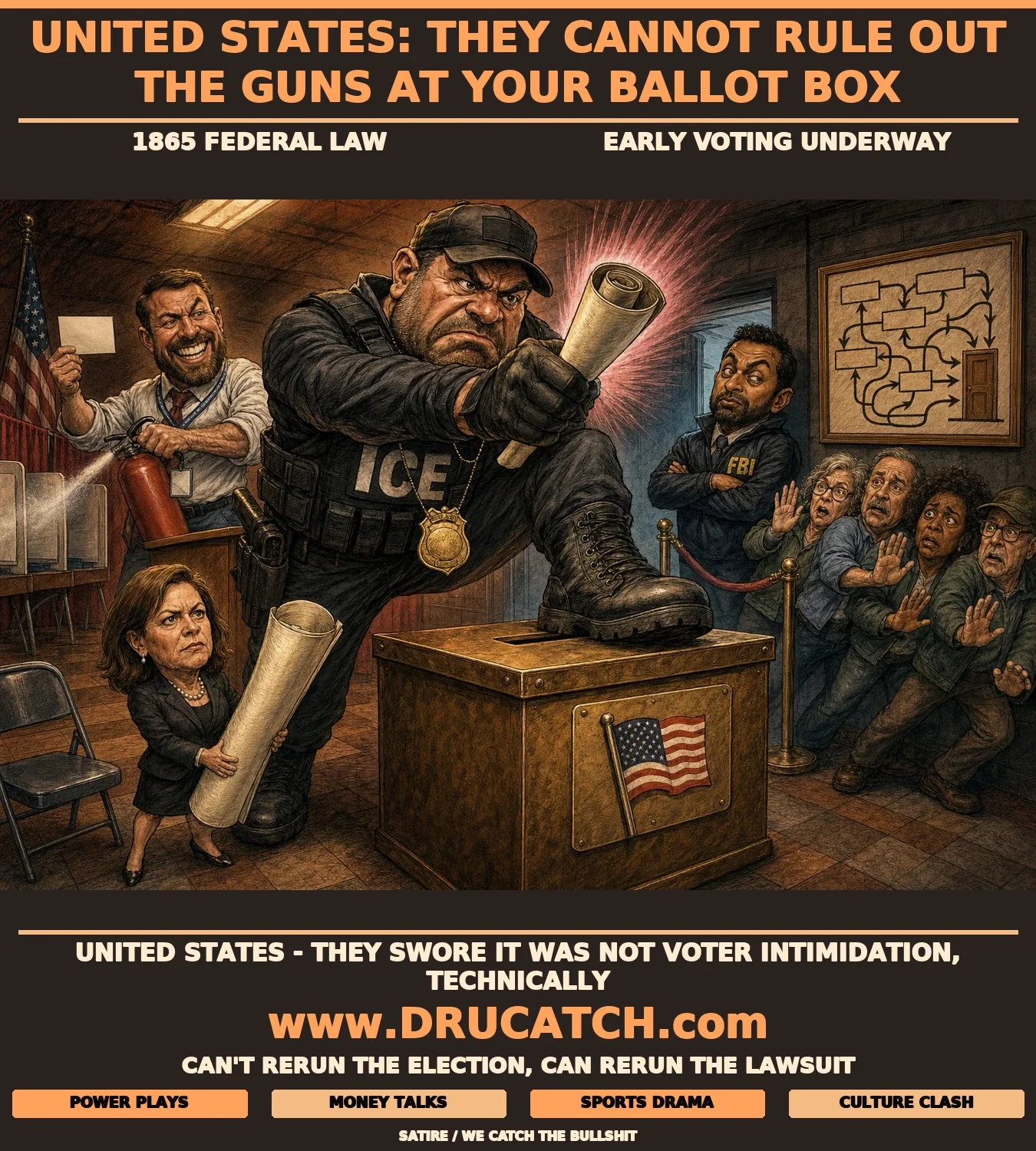
The 1865 federal law Arlington County is invoking was written by a Congress that had just watched an armed insurrection. The idea that America would need to dust off Reconstruction-era legislation to keep federal agents out of polling booths is not a legal footnote - it is a verdict on where the country currently stands.
The DHS defense is a masterpiece of careful non-denial. 'ICE is not planning operations targeting polling locations' is not the same as 'ICE will not be at polling locations.' Mullin himself told his confirmation hearing that officers would only show up in response to a specific threat - which means the entire deterrent rests on someone in Washington deciding, on Election Day, whether a 'specific threat' exists. That is a lot of discretion to hand to an administration that has already made clear what it thinks about certain kinds of voters.
You Do Not Need to Pull the Trigger to Fire the Warning Shot
Arlington has not received a single formal complaint of actual agents appearing at a poll. What it has received is enough on-the-record statements from senior officials - Mullin suggesting ICE warrants could be served at polling locations, Patel saying armed FBI agents could appear for election enforcement - that the county was forced to run emergency preparedness exercises involving election workers, police and prosecutors.
The administration created the chilling effect, then handed DHS the talking point that nothing has technically happened yet. That is the mechanism: make the threat plausible enough that voters second-guess showing up, then point to the empty polling floor as proof that nobody was intimidated. It is voter suppression with a press release attached.
A Post-Election Remedy Is Not Actually a Remedy
Coffey put the legal argument plainly: you cannot rerun the election after the intimidation occurs. That is not hysteria - that is how due process actually works when the harm is irreversible. Arlington is not asking for damages. It is asking a federal court to tell the administration, in writing and before November 3rd, exactly what its agents are and are not permitted to do inside a polling place.
The administration's answer so far is that no operations are currently planned, and that Mullin once said agents would only appear for a specific threat. That is a verbal assurance from the same officials whose public statements triggered a federal lawsuit and a round of emergency drills. If the administration genuinely has no intention of sending armed agents to the polls, a court order costs them nothing. The reluctance to agree to one is the story.


THE COMMENTS SECTION HAS ENTERED THE CHAT
Should federal courts require the Trump administration to provide legally binding written assurances that armed agents will not appear at any polling location before Election Day - or does the current DHS verbal denial satisfy the legal standard Arlington County needs to protect voters?
Join the discussion / save / share