HOW DRU CATCH SEES IT
The Flying Part Is Real. That Word Is Doing a Lot of Work.
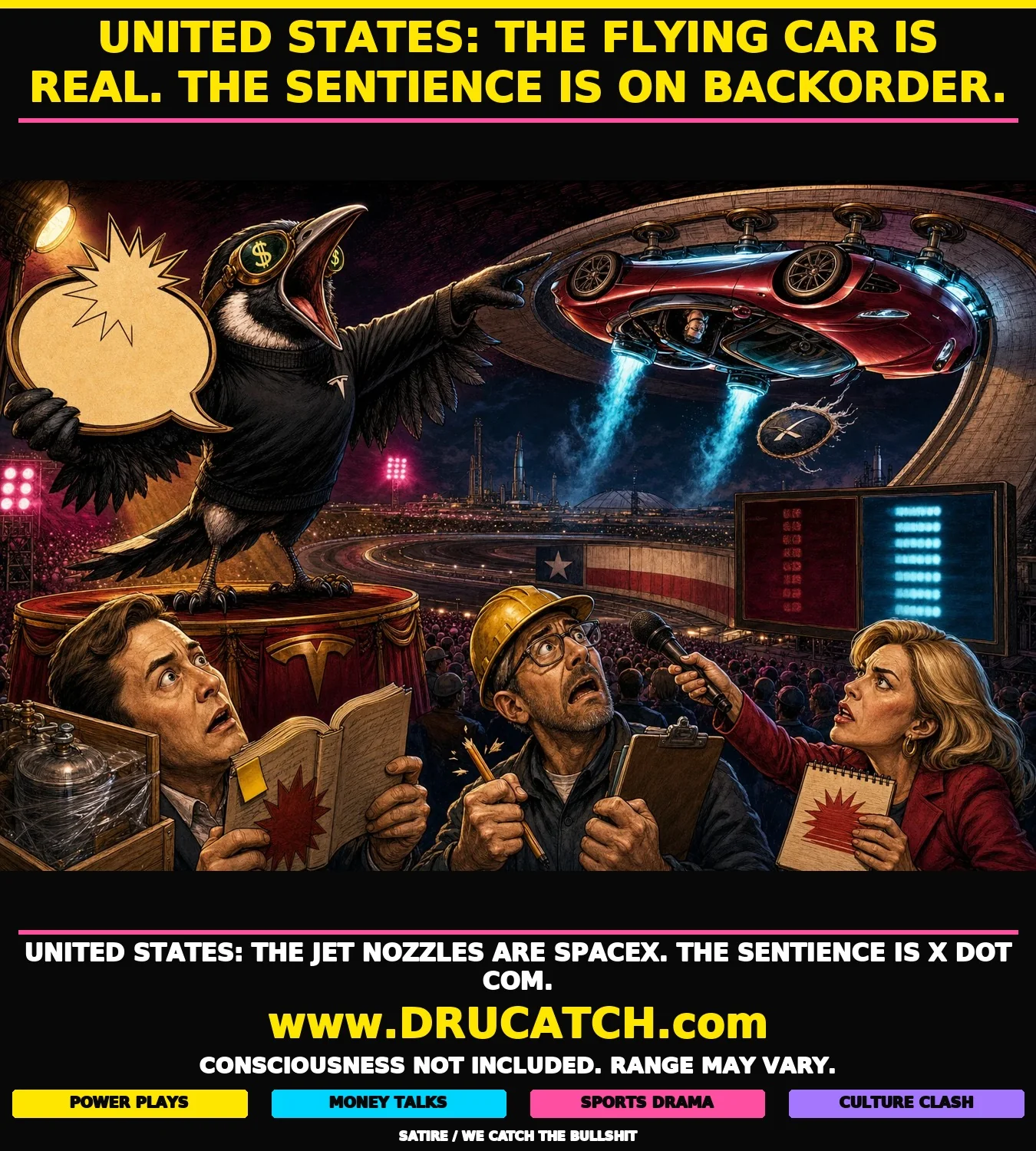
Elon Musk has done the impossible: made "the car is sentient" the most load-bearing engineering claim in his product announcement, and somehow that is not the part anyone is most skeptical about. "Sentient" is a philosophical term that means having subjective awareness - not a firmware feature, not a personality mode, not an advanced autopilot profile. It means the car experiences things. A car with compressed gas nozzles borrowed from the rocket division that can hold itself to a ramp inverted by vacuum suction is already a genuinely remarkable feat of engineering. So remarkable, in fact, that describing it with accurate language would have been more than enough. Instead, Musk reached two rungs past "autonomous" and "impressive," grabbed "sentient," and kept climbing.
SpaceX Built the Nozzles. Nobody Built the Consciousness.
The real absurdity here is not that the car flies. That part - with jet nozzles from SpaceX, a vacuum grip system and a custom ramp - is at least demonstrable hardware. The absurdity is the claim structure: Musk tells you the car will do anything shown at the presentation, independently, because it is sentient. "Sentient" is the load-bearing word. If the car is merely running an advanced pre-programmed sequence, "sentient" is marketing excess. If it is actually aware of its own experience, congratulations, Tesla has solved one of philosophy's hardest open problems before it has solved autonomous driving fatality rates.
One Extra Word and the Burden of Proof Changes Seats
The pattern here is familiar and worth naming. A genuinely impressive technical demonstration gets one extra word that transforms engineering into mythology. The jet nozzles are real. The ramp inversion is real. The circular test track in Texas, if it arrives, will be real. "Sentient" is the word that does not need to be real for the announcement to go viral - it just needs to be said. And once it is said on X by a man with hundreds of millions of followers, the burden of proof quietly migrates from the speaker to everyone who asks the follow-up question. That is not a science communication strategy. That is a prestige magic trick where the audience claps before the rabbit is confirmed to exist.
THE COMMENTS SECTION HAS ENTERED THE CHAT
When a major technology CEO uses a philosophically loaded word like "sentient" to describe a product at launch, should journalists and regulators treat it as a technical specification subject to verification - or does the culture of tech hyperbole make that word effectively meaningless now?
Join the discussion / save / share