HOW DRU CATCH SEES IT
The Privacy Feature That Kept Its Promise While Breaking It
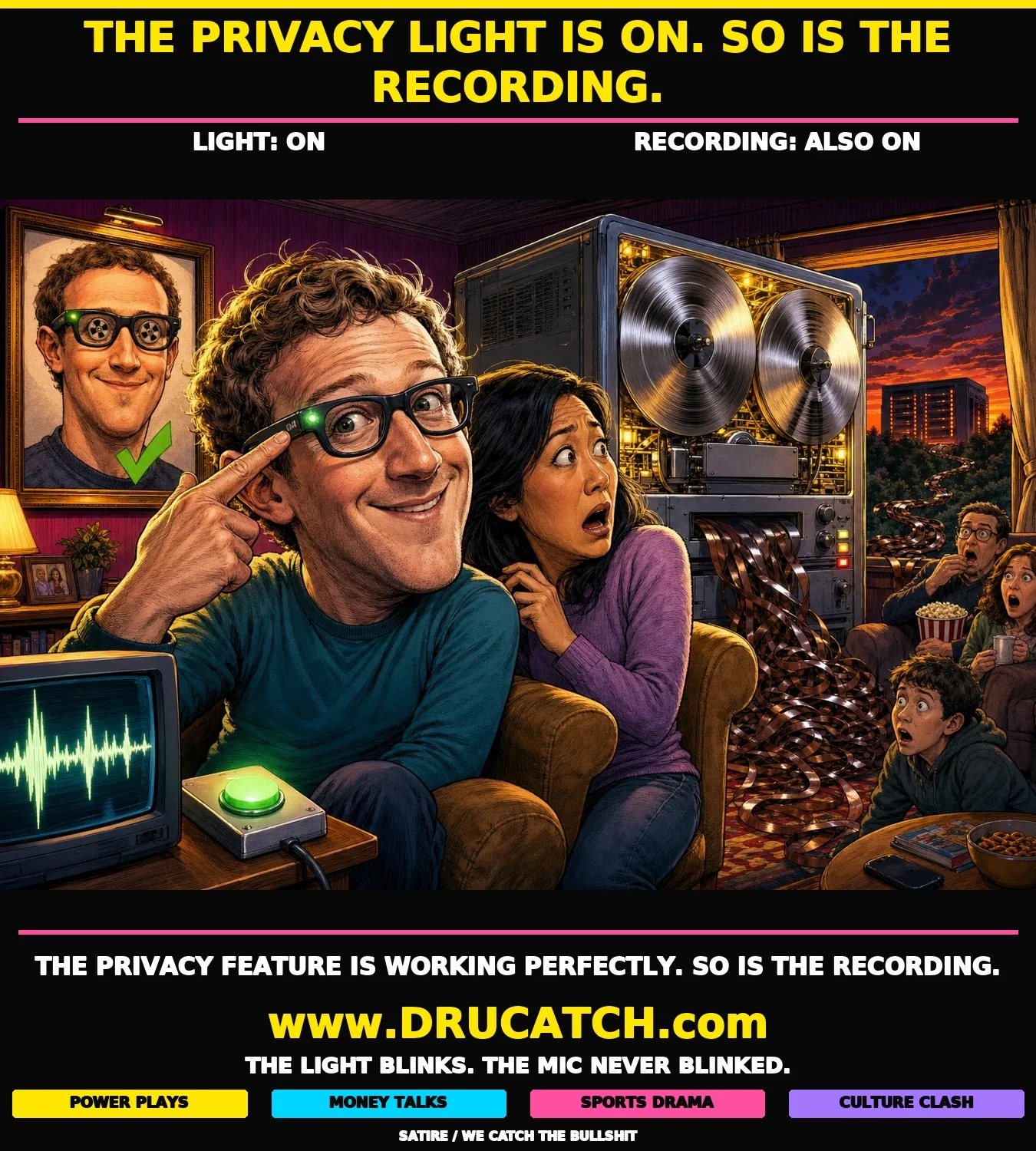
Meta's entire published privacy guarantee for the Ray-Ban smart glasses was a blinking LED. That was the promise: a light blinks, you know you're being recorded. Simple, elegant, completely undermined by the fact that the glasses were recording conversations with the light doing exactly what it was supposed to do - blinking away, cheerfully green, while every word went straight into Meta AI history.
This is not a bug that slipped through the cracks of some obscure sensor firmware. The indicator light was Meta's primary public answer to the obvious question: how do I know these things aren't recording me? The answer broke. The thing that was supposed to prove the glasses weren't recording you was running perfectly while the glasses recorded you. That's the privacy feature functioning as designed and still failing as intended.
Follow the thread: Meta Answered Every Question Except the One the Judge Asked.
Fixed. Unexplained. Nobody Asking Nicely Enough.
Meta's response - 'this issue has been resolved' with a reminder that users can manage their settings - is the corporate equivalent of a landlord patching a gas leak and refusing to say what caused it, how long it was leaking, or how many apartments were affected. One user reported the problem across three separate pairs of glasses, having deliberately turned off the wake-word-free feature, and still found audio and transcriptions building up in Meta AI history. Meta has not confirmed whether this was a software update, a hardware interaction, or something else entirely.
The company modified the glasses in August so they cannot record when the indicator light is physically covered. A few weeks later, the glasses were recording without anyone covering anything. That upgrade closed a loophole Meta apparently knew existed; this one closed a loophole Meta has still declined to describe.
When the Decoration Is the Security System
The earlier Sama investigation - Swedish journalists reporting that Kenya-based workers had viewed intimate recordings of users' partners without anyone's knowledge - should have been the moment Meta explained in detail exactly how recordings travel from wearable hardware to human reviewers. Instead it generated a lawsuit and a Texas AG investigation, and Meta's privacy architecture for the glasses remained: the light blinks. Now the light blinks and recordings happen anyway.
If the architecture of trust is a blinking light, and the blinking light doesn't stop the recording, Meta doesn't have a privacy feature. It has a decoration. Norway is among the countries now considering a temporary ban - which is what happens when a company's answer to 'how does this not record everything' turns out to be 'we asked it not to.'




THE COMMENTS SECTION HAS ENTERED THE CHAT
If a device's only privacy safeguard is an indicator light, and the device records without that indicator failing, does the indicator actually protect users - or does it just give the manufacturer a defense?
Join the discussion / save / share