HOW DRU CATCH SEES IT
The Safety Pledge With Better Attendance Than the Train
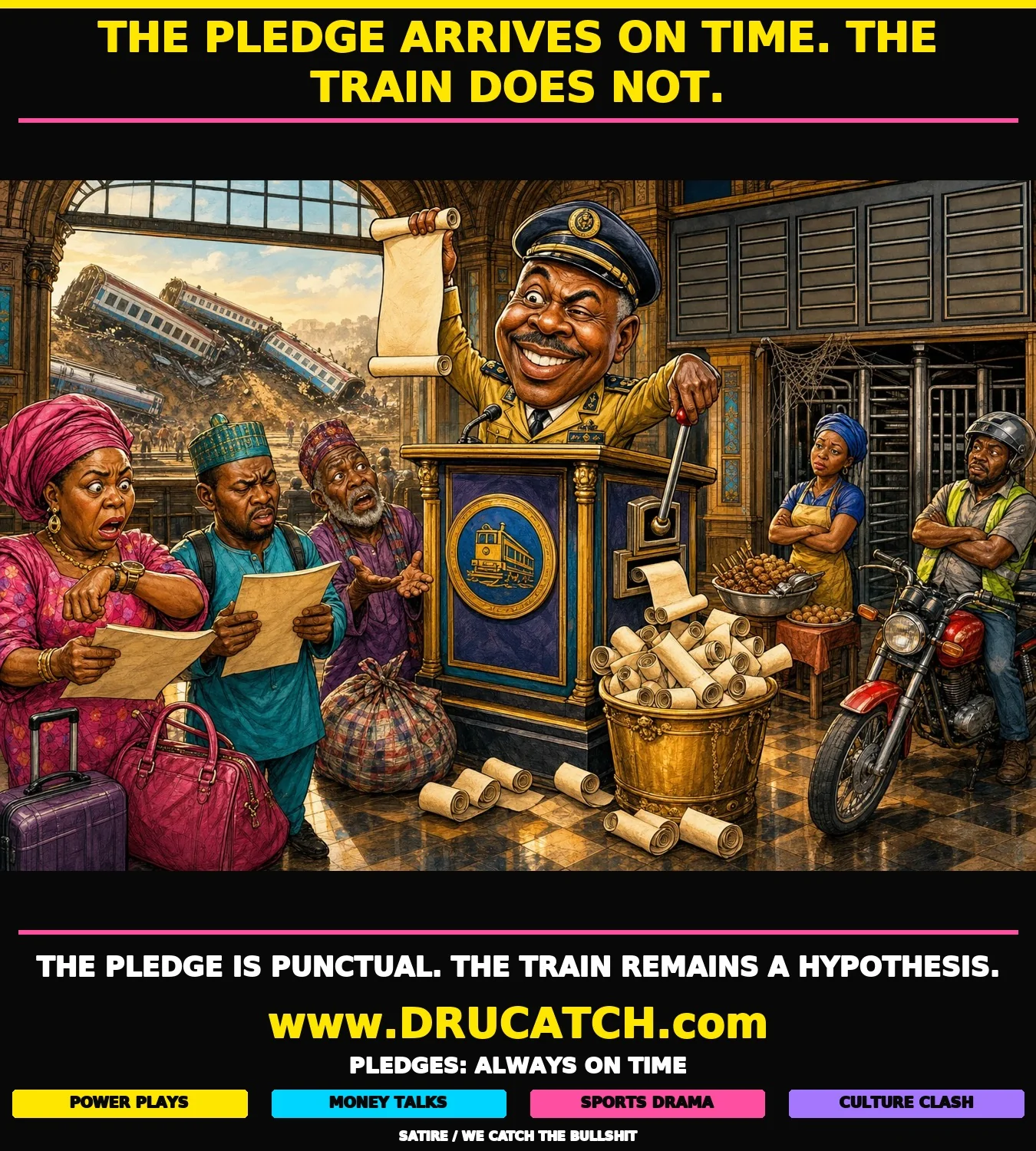
Nigeria spent 33 years building the Itakpe-Warri railway. The NRC has spent six years perfecting the press release. After every suspension - technical faults in February 2025, engine failures in April, urgent track repairs in August, a derailment in October, another suspension in May 2026 and finally a fatal crash in June that killed four people - the corporation has issued a near-identical statement committing to safety, reliability and improved service delivery. At this point the pledge has a better on-time record than the train.
Follow the thread: Iran Has Nothing to Do With the Houthis. Also, Could the Houthis Please Stop?.
Four Dead, Months Later, and the Best Answer Is Maybe the Brakes
The cruelest detail is not the crashes. It is the corporation's own preliminary report, which admits investigators have only working hypotheses about why the June derailment happened - a possible bogie or wheel defect, maybe the manner of brake application. Four people are dead and the official explanation is a shortlist. An independent Nigerian Safety Investigation Bureau inquiry is ongoing and the final report remains pending. The infrastructure is standing. The answers are not.
Ordering More of Something That Does Not Reliably Show Up
This is what institutional absurdity looks like at full speed: a government builds the tracks, commissions the trains, slaps its name on the ribbon-cutting photos - then cannot tell you, months later, why the coaches went sideways. Meanwhile, stakeholders at Ujevwu are calling for the Federal Government to procure more trains while the one service it operates keeps breaking, crashing and disappearing. Asking for more of something that does not reliably show up is either optimism or a very expensive habit. For the food sellers, transport operators and traders whose livelihoods orbit Ujevwu station, every suspension is not an inconvenience. It is the economy stopping. The train's absence has consequences that no safety pledge, however earnestly laminated, actually addresses.



THE COMMENTS SECTION HAS ENTERED THE CHAT
Nigeria's NRC has pledged safety improvements after every disruption on the Warri-Itakpe line, yet the cycle of suspensions and derailments has continued. Should the Federal Government bring in independent operational management for the service, or is the fundamental problem a lack of rolling stock and funding that more pledges cannot fix?
Join the discussion / save / share