HOW DRU CATCH SEES IT
The $25 Billion Invoice Nobody Quoted On
A New Mexico judge reportedly issued a court order requiring Meta Platforms to pay $25 billion in penalties over the Cambridge Analytica data scandal, per a court filing reported by Breitbart News on October 22, 2026. A jury had previously found that Meta misled consumers about user data allegedly harvested without consent and used in Donald Trump's 2016 presidential campaign. Meta has not provided a quoted response to this specific order in the available evidence, which is itself a kind of answer.
The $25 billion figure, if upheld, would represent one of the largest data-privacy penalty judgments against a technology company on record. That context matters: this is not a regulatory slap on the wrist. This is a state court in New Mexico telling a company worth hundreds of billions of dollars that its conduct toward ordinary users - people who were not asked, told, or compensated - carries a price tag with a lot of zeros.
Class C Stock: Accountability Has a New Workaround
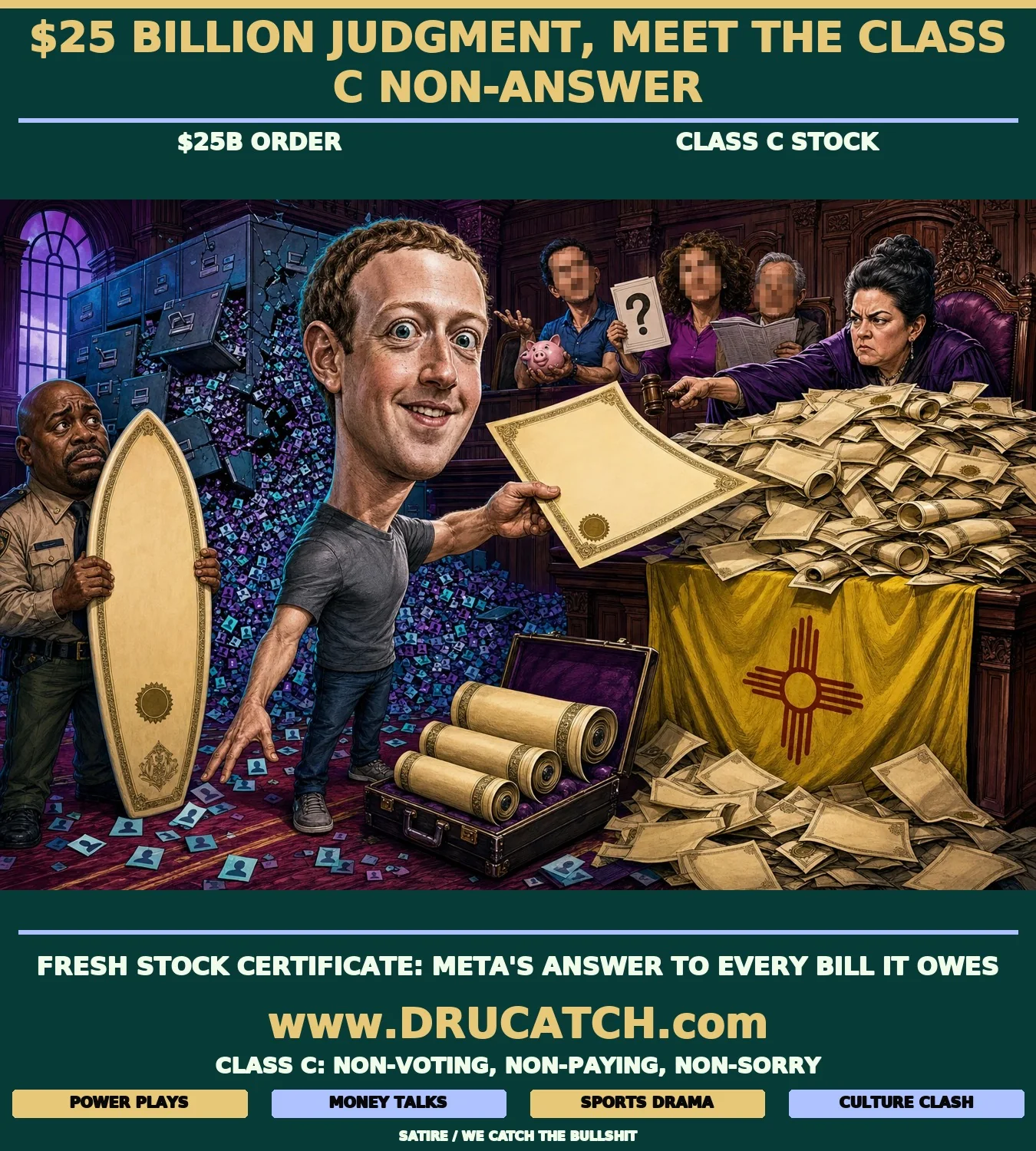
The day before the $25 billion order was reported, Meta created a new non-voting Class C common stock. According to a prior reported event, the explicit purpose was to allow CEO Mark Zuckerberg to pay a potential California Proposition 40 billionaire wealth tax liability without surrendering majority voting control over the company. A Meta Special Committee described Zuckerberg's continued in-person presence as 'critically important' - which is the kind of language you deploy when the retention gesture is a new category of shares designed specifically for one person.
The timing is not an allegation of wrongdoing - corporate governance maneuvers and court orders do not need to be coordinated to be revealing. What they reveal together is a pattern: external pressure arrives, Meta builds a new structure around its founder, and nothing about who runs the company or how it runs changes. The fine is a line item. The voting architecture is permanent.
When the Reflex Is Always More Architecture
The Cambridge Analytica scandal is nearly a decade old. The users whose data was allegedly swept up without consent have not gotten their data back, their privacy restored, or a meaningful structural change in how Meta handles what it knows about them. What they have watched instead is a company that has become extraordinarily skilled at meeting accountability with complexity - more classes of stock, more appeals, more committees finding the CEO critically important.
DruCatch's interpretation: Meta does not need to defeat accountability. It just needs to outlast it. A $25 billion judgment from a New Mexico state court is not the end of anything - it is the beginning of a very expensive, very slow legal process in which Meta's structural advantages compound over time while the underlying behavior that produced the judgment stays safely insulated behind a founder who cannot be outvoted, outspent or apparently out-waited.




THE COMMENTS SECTION HAS ENTERED THE CHAT
When a company's institutional reflex to every fine, judgment, and tax bill is to invent new financial architecture rather than change behavior, at what point does the legal system stop being an accountability mechanism and start being just another cost of doing business?
Join the discussion / save / share