HOW DRU CATCH SEES IT
The Rally Promise and the $100 Reality
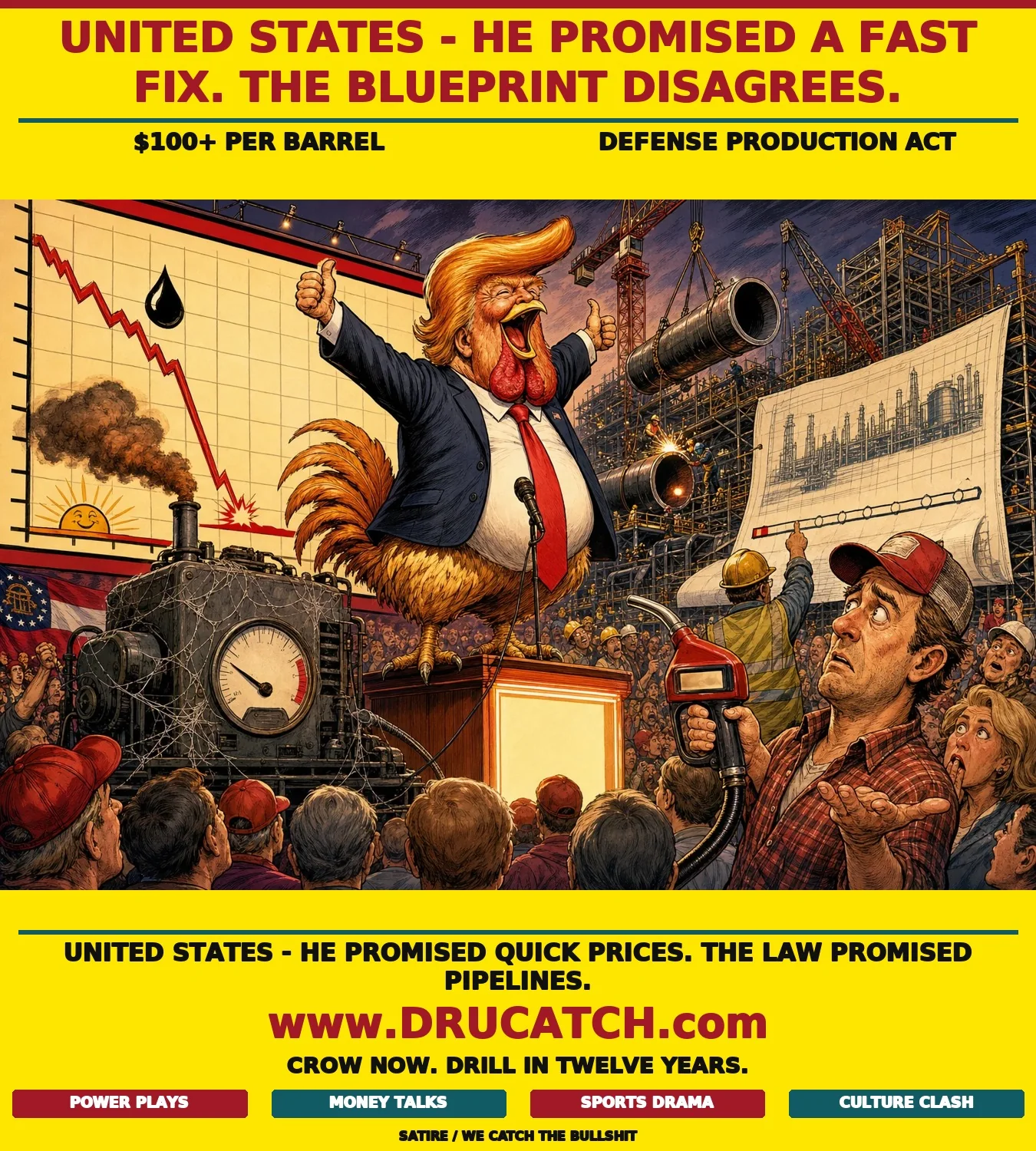
Oil prices have pushed past $100 per barrel, squeezed upward by the blockade across the Straits of Hormuz and Bab el-Mandeb and by Ukrainian strikes on Russian refining capacity. At a midterm rally in Georgia, President Donald Trump offered the crowd a straightforward forecast: the Iran war is nearly over, and once it ends, prices will tumble fast. European governments had already moved to tap roughly 100 million barrels from emergency diesel and crude reserves, and diesel sanctions against Russia were being softened. Trump's framing was unambiguous - short-term pain, rapid relief.
Trump also walked the crowd through the military campaign's scorecard: Iranian naval assets destroyed, aircraft grounded in wreckage, leadership ranks cleared out tier by tier. He described a conflict in its final chapter. That portrait is the load-bearing wall under the price promise - war concludes, disruption evaporates, markets calm down. Compact logic. The kind that works well under rally lights.
What Activating a Cold War Statute Actually Means
At the same moment Trump was sketching a near-term price recovery for Georgia voters, his administration was pulling a different lever entirely - activating a section of the Defense Production Act, Cold War legislative architecture built for exactly the kind of heavy, slow industrial lift that campaign speeches rarely describe. The target: financial incentives to expand domestic production, refinery capacity, pipeline infrastructure and liquid fuel storage. Trump's own directive supplied the rationale: without intervention, the US would fall short on energy services - both in volume and timing - because of capital constraints, extended preparation timelines, permitting backlogs, infrastructure gaps and supply chain friction.
The Defense Production Act is not the statute you reach for when a market disruption is weeks from resolving on its own. It is the mechanism designed for situations where the underlying industrial base simply does not exist at the scale demanded - and where closing that gap is measured in years, not news cycles. Permit queues do not clear because a ceasefire gets signed. Refineries do not appear because a rally went well. They appear when someone finances, permits and builds them - which is precisely what the directive acknowledges has not happened yet.
The Gap Between the Microphone and the Law
Invoking Cold War-era industrial mobilization law sends a specific signal: the problem is structural, not situational. A temporary price spike caused by a war nearing its end does not require emergency production statutes built for multi-decade capacity gaps. A chronic deficit in refineries, pipelines and fuel storage does. Both statements cannot be fully true at the same time - that prices will collapse shortly after the war wraps up, and that the US currently lacks the infrastructure, capital and permits to produce energy at necessary scale. One of those claims describes a passing weather system. The other describes a missing roof.
The Georgia crowd received the weather report. The Defense Production Act directive received the structural assessment. DruCatch takes no position on Trump's timeline for the Iran war - that remains his stated claim. The observable contradiction is narrower: a politician who genuinely expects prices to self-correct in the near term does not simultaneously activate a law whose own enabling language cites preparation periods and bottlenecks that outlast any ceasefire announcement. Multi-year industrial mobilization is not a short-term hedge. Pulling that lever tells you something about what the administration actually expects - regardless of what the microphone said in Georgia.


THE COMMENTS SECTION HAS ENTERED THE CHAT
If Trump's own Defense Production Act directive acknowledges years-long preparation periods, supply chain bottlenecks, and financing constraints as barriers to US energy capacity, is it reasonable to also claim oil prices will fall "in a very short time" once the Iran war ends? What should voters demand from leaders who make both statements simultaneously?
Join the discussion / save / share